 |
993 Park Ave., at 84th St. Gideon Louis
lived in this 49-unit apartment building,
which was built in 1915. |
The following post overlaps with others on the Early Boissevains (First 6 Generations), the Charletjes and the American Boissevains. With Noah Sisk (GenB), I have reorganized and consolidated these posts, using the extensive computerized survey by Matthijs Boissevain and the 1988 Blue Book, the Nederlands Patriciaat.
NEW YORK, March 16, 2016–This post is about a branch of the Boissevain family that I knew nothing much about until 2016. For the prior generations, go to Early Boissevains.
Daniel Sr. is the father of Daniel Boissevain Jr. and Gidéon Jérémie Boissevain (1796-1875, Nederlands Patriciaat, NP 48), both of whom had descendants who came to the United States. The Nederlands Patriciaat is called the "Blue Book" of the Netherlands, about burghers (merchants, not nobility). The "Red Book" covers the Dutch nobility, which has tended to be democratic like most of the Scandinavian aristocracy.
Daniel Jr. (Gen5)
Daniel's second son (the great-great-grandson of Lucas) is identically called Daniel; he is disambiguated from his father by using "Jr." or providing his birth-death coordinates (1804-1878 NP 84). This Daniel was the younger brother of Gidéon Jérémie; he had a son Mijnhard Johannes Boissevain (Gen6, 1870-1924), also spelled Mynhard, Mijnhart and Mijnhardt in Dutch. The name was transliterated to Meinhart, it seems, when the family came to the United States.
Mijnhard's son Gideon Louis Boissevain (Gen7, 1870-1924) emigrated to the United States and married Helen Arabella Magee, b. 1872, living in due course at 993 Park Avenue. They had two sons, Meinhart Boissevain (Gen8, b. July 14, 1896, d. Oct. 1928, age 32) and John Magee Boissevain (b. 1901, NP 100).
During the Panic of 1907, Gideon Louis Boissevain and his brother-in-law (?) John Magee called on J. P. Morgan to ask him to help save the Knickerbocker Trust. Morgan refused, and the Trust closed. The deposits of its customers were locked up for months. But at the end of a period of hunting for new equity, the Knickerbocker Trust reopened and G. L. Boissevain was said by Morgan's 1911 biographer Carl Hovey to have been key to its revival.
Meinhart Johannes Boissevain apparently prospered in the go-go years of the 1920s, possibly because he inherited money from his father (who was in the United States when he died in 1924) when he was 28 years old, amidst soaring stock prices. His investments doubtless grew rapidly during 1924-1928 years. He died tragically young, 32.
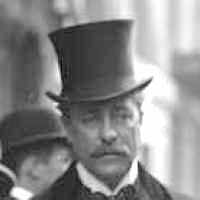 |
Gideon Louis Boissevain,
1870-1924. |
Did Meinhart miss the Crash? The dark financial clouds that came to a head in October 1929 were already filling the sky, and I wonder whether he could see ahead, was overextended and died from the stress. It is a pity
he didn't write his autobiography.
Walraven (Wally) van Hall went to New York City in August 1929 to look for work in the shipping business. I always thought that the likely connection was with well-off Boissevain relatives in New York City–Robert, Jan and Eugen of Boissevain & Co. They had just expanded their space on the top floor of the Whitehall Building when the financial clouds started to gather. But Meinhart Boissevain may have been anticipated, until he died, as one of the expected hosts. Wally's son Aad does not remember talk about any of the Boissevains; possibly Wally or his widow didn't want to dwell on this disappointment.
Another possible family connection in the shipping business for Wally van Hall–suggested by Charles (twin of Hester) van Hall–was Hester Boissevain van Hall's son Maurits van Hall (born 1901). Maurits was director of the Verenigd Cargadoors Kantoor (United Shipbrokers Office), abbreviated VCK. (With Charles I visited his youngest daughter Ellen van Hall Wurpel in February 2015.)
Unfortunately, 1929 was a bad year to look for a job in New York City. Wally gave up finding a shipping job and instead worked with his older brother Gijs van Hall in banking; however, after 18 months he returned to Holland without trying to extend his visa. By living through the Crash of 1929 he must have had the best financial education anyone could ask for and after leaving New York he got a job immediately as a banker with his family back in the Netherlands. Ten years later he became the Banker of the Resistance, for whom the dry and skeptical official writer of the 14-volume history of World War 2 in Holland, the late Loe de Jong, had nothing but extravagant praise.
John Magee Boissevain, the other son, married twice and had a daughter by each wife, so the Boissevain name disappeared from the branch but interest in the Boissevain family did not die with it.
 |
Estrella Boissevain in fashion shot,
about 1938. Photo by Horst P. Horst
[Horst Paul Albert Bohrmann] |
1.
Estrella and Cynthia. John's first wife was Estelle (nicknamed
Estrella–"star" in Spanish) Braniff Carroll Boissevain. She grew up in New York City and married John on Aug. 25, 1923, a month after the well-publicized wedding of Edna St. Vincent Millay to Eugen Boissevain. Photos of Estrella were taken by famous photographers of the day like Horst P. Horst and George Hoyningen-Huene. She was featured in
Vogue and
Harper's. By Estrella John had a daughter, Cynthia Anne Boissevain, born July 26, 1924, in San Francisco. Cynthia married Thomas F. Madigan; they had five children, of whom four survive. Her son Nick Madigan, one of the four surviving children, says:
My mother Cynthia is alive and well at 92, living on the coast in Wales and at present visiting cousins in Mexico [...].
2.
Suzanna and Natasha. John's second wife was Suzanna Saroukhanoff, born in Tiflis (then in Russia, now in Georgia) on August 11, 1907. By her, he had a daughter Arabella Helen (Natasha) Boissevain, born June 14, 1932. Natasha married twice: (1) Malcolm Pray Jr. and (2) F. Richards (Dick) Ford III, Princeton '50 and Virginia Law School, son of the late Frank Ford, Princeton '26; they lived mostly in Greenwich, Conn.
Natasha did not have children with Dick Ford, but he came with five of his own from his first marriage. With Pray she had four children–three daughters (Sabrina, Melanie known as Lilly, and Tina)–and a son, Malcolm. The daughters are still living; Lilly Pray resides in Boulder, Colo. Natasha died Feb. 13, 2005.
Charles
Leidschendam Boissevain wrote to me about going to Natasha's home in 1995:
My wife Liset and I well remember visiting Natasha in Greenwich, Conn. She certainly was a nice person. And a beauty! When she was 18, we found a full-page ad in the Saturday Evening Post telling us: "Miss Natasha Boissevain, young debutante of the 1950 season, makes her bow to society. Discriminating in her choice of cigarettes, Miss Boissevain says: 'I find Herbert Tareyton's cork tip particularly nice, and so many of of my friends do, too.'" She was promoting sport and gym clubs for physical exercise. As I was involved with sport also (then!) we had something to talk about. (In the 1990s I ran some marathons, but I am too old for that now – I have to be a bit careful with my two new hips, though I did run this morning a little little bit, and very slowly.)
The advertisement is at right.
Notes
Daniel Boissevain Sr.: 1772-1834,
Nederlands Patriciaat, 45.
Gideon Jeremie Boissevain: 1796-1875,
Nederlands Patriciaat, 48.
Sources
Hovey, Carl.
The Life Story of J. Pierpont Morgan: A Biography. New York, 1911.
Available via Google Books.
Correspondence with Nick Madigan and Charles
Leidschendam Boissevain, March-April 2016.
Charles Boissevain sent me the following page (in Dutch) about Daniel Boissevain (1772-1834):
Acknowledgment
I thank Nick Madigan for getting in touch with me about his family, and I thank both him and Charles
Leidschendam Boissevain (son of Bob Boissevain, Sr., who died in a Nazi concentration camp in 1945) for helping me figure out some of the connections.
This blog is sponsored by Boissevain Books, which keeps in print books by Hilda van Stockum, daughter of Olga Boissevain, and publishes new books. To buy a book and support keeping this work alive, go to www.boissevainbooks.com.


