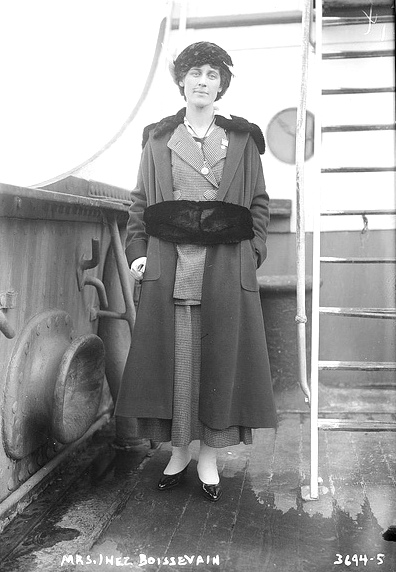
Showing posts with label Eugen Boissevain. Show all posts

Sunday, April 25, 2021

MARCONI | Jamesons and MacDonnells

Guglielmo Marconi
April 25, 2021—This day was born (in 1874) Guglielmo Marconi, in Bologna, Italy.  He has at least three connections to Inez Milholland, all of them via the Jamesons, the Irish whiskey family.

First, he was engaged to Inez for several months but his mother didn't like the idea. He was working on his ship-to-shore communications on a Cunard ship, as I recollect the Carpathia, and Inez was on her way to the Willard school in Berlin. She had to take some courses so she could qualify for entrace to Vassar, which at that time had specific rigorous requirements for admission. They were engaged after a shipboard romance, but it seems that Marconi's Irish mother, a member of the Jameson whiskey family, did not want to have an American whisk off with her son. He broke off the engagement on the basis that she was too young. They remained friends for the rest of her life.

Second, his Jameson mother was of crucial help to his company. He was interested in electricity and used the work of Heinrich Hertz to use electromagnetic or "radio" waves for communication. Marconi began building his own equipment and conducting experiments when he was twenty. In 1895, he moved his equipment outdoors and was able to transmit over a hill, at a distance of about a mile. Six years later, he sent and received a signal across the Atlantic Ocean. The two radio operators aboard the Titanic were Marconi employees, and the British Postmaster General said: "Those who have been saved, have been saved through one man, Mr. Marconi ... and his marvelous invention." Nikola Tesla was Marconi's chief competitor, in addition to the telegraph companies that relentlessly resisted Marconi's invention throughout his life. Tesla said he had been ready to transmit a signal over fifty miles in 1895, but a fire destroyed his work. Marconi's work was performed using seventeen components patented by Tesla, but Marconi's mother's connections with the Jameson whiskey empire helped him stay in business, as well as support from Andrew Carnegie and Thomas Edison. Tesla's patents were overturned in favor of Marconi's in 1904, and Marconi received the Nobel Prize in physics in 1911. However, in 1943, the U.S. Supreme Court upheld Tesla's original patent. Lots of injustice to go round. Inez Milholland's father, John E. Milholland, was actively soliciting business from the British Postmaster General (as well as the U.S. Postmaster General, but that is another story entirely). Mr. Milholland was seeking to build and lease a pneumatic tube system that would deliver mail within London int he same way it transmitted sales slips within department stores.

Third, Inez married another Jameson relative, Eugen Boissevain. Eugen's father was a young Dutch reporter covering the Irish Horse Show, a trade fair, when he got sick. He was brought to the Dalkey home of the MacDonnells ("Sorrento Cottage," because the view of Bray was like the view at Sorrento) and young Emily Heloise MacDonnell fell in love with the young man she was looking after. She moved with him to Amsterdam and never really picked up the Dutch language—she spoke English with her children and their English governess, Polly. Three of the Boissevains' eleven children moved to the United States (Olga Emily, Robert and Eugen Boissevain). A fourth of the eleven children, Jan, lived in the United States for a while, married an American actress (Charlotte Ives) and finally settled in the South of France on the Cap d'Antibes. I visited her in 1959. When Eugen first met Inez at the restaurant of the Holland House in New York City, he was working for Guglielmo Marconi's company.

Saturday, October 13, 2018

MAHLER | First Public Piano Concert, Oct 13, 1870

Mahler at 43.
NEW YORK CITY, October 13, 2018–This day in 1870, at ten years of age, Gustav Mahler gave his first piano concert.

Mahler was born in Bohemia on July 7, 1860. He went on to become an early world-famous conductor. He was also a composer, with ten symphonies to his credit when he died on May 18, 1911 at a young 50.

His music was appreciated by other leading conductors, and one of his biggest followings was in Amsterdam, at the Concertgebouw, which was founded in part through a campaign by Charles Boissevain, editor-publisher of the Algemeen Handelsblad.

Members of the Boissevain family were heavily involved with the Concertgebouw in the first few decades of the 20th century and several became friends of Mahler. A famous photo by Han de Booy (married to Hilda Boissevain and therefore my great-uncle) of Mahler with the Concertgebouw crowd was featured on a Dutch stamp.

He graduated from the Vienna Conservatory in 1878 and after a series of apointmenets at various opera houses he became in 1897 director of the Vienna Court Opera (Hofoper). Mahler converted to Catholicism to secure the post, but was regularly attacked by the anti-Semitic Austrian press.

Photo of Mahler by Han de Booy, at
Zandvoort, Holland; de Booy married
Hilda Boissevain, sister of Inez
Milholland's husband Eugen. 
Years after his death, during the Nazi occupation of Amsterdam, Mahler was allowed to be performed initially because he was German. But because he was Jewish, performing his music was discouraged and Wehrmacht soldiers were sent to stand in the back as a signal. The Concertgebouw was in the middle of the dispute, and its decisions pleased neither the occupiers nor the Dutch patriots who exiled the conductor after the war.

Ironically, the ban against Mahler piqued interest in his work and after 1945 his work became more popular than it was during his lifetime. Also, his music was advanced when he composed it, but with many other conductors following in his footsteps the modern ear is more attuned to his music. He became one of the most frequently performed of composers.

BBC Music Magazine surveyed 151 conductors in 2016 and they ranked three of Mahler's symphonies in the top ten symphonies of all time.

As a conductor, he was one of the greatest opera interpreters in history, including the works of Wagner, Mozart, and Tchaikovsky. He was for a time director of New York's Metropolitan Opera and the New York Philharmonic.

Monday, August 6, 2018

BIRTH | Aug 6–Inez Milholland Boissevain 1886-1916

This poster of Inez is
available for $30.
August 6, 2018–Inez Milholland was born this day in Brooklyn, New York. She was the first child of John E. Milholland, a second-generation immigrant from Northern Ireland and a newspaper editor who became wealthy as owner of a pneumatic tube system he sold to post offices. John Milholland was married to Jean Torry, a proper Bostonian with Scottish ancestry.

Inez grew up first in Brooklyn and then on Madison Square Park in Manhattan in the Flatiron District (subject of a recent story in The New York Times). 

Inez was married in London in July 1913 to Eugen Boissevain (my grandmother's brother) after a whirlwind courtship aboard a Cunard liner (the Mauretania, sister ship of, and faster than, the Lusitania). 

She died in November 1916 while traveling only with her sister Vida on a speaking tour to take Woodrow Wilson to task for not supporting the Anthony Amendment. She collapsed during a speech in Los Angeles, right after the sentence: "How long, Mr. President, must women wait for liberty?" This was a popular banner that the National Woman's Party picketers carried during the long picket of the White House that turned the tide in favor of suffrage.

An enlarged durable version of the poster of Inez that was prepared after her death is available from Boissevain Books for $30: https://bit.ly/2OIDLNL.

I wrote about Inez and her death on the 100th anniversary of her death two years ago:
https://bit.ly/2i7HnLO

Inez Milholland was recently nominated among ten women to be the subject of a statue in NY City:
https://www.nytimes.com/2018/07/26/nyregion/women-monuments-new-york-city.html

Thanks to Long Island Suffrage for remembering Inez's birthday! http://longislandwomansuffrage.com/?p=3132


Monday, October 23, 2017

BIRTH | Oct. 22 – John Reed

Russian Versions of Reed's Works,
in English and Russian.
October 22, 2017 – This day in 1887 was born in Portland, Oregon, American journalist John Silas “Jack” Reed.

He's best known as the author of Ten Days That Shook the World (1919), his eye-witness account of Russia’s 1917 "October" Revolution.

He is included in this Inez Milholland blog because:
  • He was an older contemporary of Inez's brother John ("Jack") Milholland at Harvard. Both of them tried out for the Harvard football team.
  • He was a part of Inez Milholland's circle of radical feminists and pacifists.
  • His famed trip to Russia in 1917 was financed, according to their friend Max Eastman, through an appeal to Alma Vanderbilt Belmont and others by Inez's widower Eugen Boissevain.
***

Reed was from a wealthy Portland family. His mother, Margaret Green Reed, was the daughter of a man who owned Oregon's first gas works, first pig-iron smelter, and the City of Portland water works.

At Harvard, Reed tried out for football but did not make the team (unlike Inez's brother Jack, who became the team's well-publicized designated drop-kicker). While a student, Reed attended meetings of the Socialist Club headed by Walter Lippman and became an admirer and friend of Lincoln Steffens, the famed muckraker. His favorite professor was English Professor Charles Townsend "Copey" Copeland (1860-1952), who recommended that his students interested in a writing career get involved in real-life gritty working experiences as a way of generating something to write about.

Reed graduated from Harvard in 1910 and after several gritty jobs began in 1913 writing for Max Eastman's anti-war and socialist magazine, The Masses. In 1914 he covered the revolution in Mexico and recorded his impressions in Insurgent Mexico. In 1915 he met the leftist journalist Louise Bryant. He said:
She is coming to New York to get a job with me, I hope. I think she's the first person I ever loved without reservation.
They were married that year. They spent that summer in Provincetown, at the tip of Cape Cod, with a group of other writers from Greenwich Village that included Floyd Dell and Theodore Dreiser. Several of them established the Provincetown Theatre Group at the end of a wharf, which inspired another theater on McDougall Street in New York City with the same name. Bryant wrote:
Never were so many people in America who wrote or painted or acted ever thrown together in one place. 
Other writers like Eugene O'Neill and Eugen Boissevain's second wife Edna St. Vincent Millay joined the group in later years.

Arrested often for his coverage of strikes, Reed rapidly became established as a radical leader and helped form the U.S. Communist Party. He covered World War I for Metropolitan magazine and wrote The War in Eastern Europe (1916).

Reed sought money to go to Russia in 1917 to cover what became the Russian Revolution. Eugen Boissevain, now Inez Milholland's widower, spoke with some of their New York City friends, including Alma Vanderbilt Belmont, and, according to Max Eastman, was the key person who put together Reed's funding.

In Russia, Reed befriended Lenin and was an eye-witness to the early days of the 1917 Bolshevik Revolution. Reed wrote back with enthusiastic correspondent reports that generated U.S. headlines.

He returned to to New York and when the U.S. Communist Party and the Communist Labor Party split in 1919, Reed became the leader of the latter. Indicted for sedition (treason), he escaped via Scandinavia to Russia. But in his final years he was disillusioned by the loss of democracy after the Russian Revolution and especially by restrictions on his own travel.

He died in 1920 in a Moscow hospital of scrub typhus, which is associated with poor hygiene and cold weather. He is buried in the Kremlin Wall Necropolis for Bolshevik heroes, along with Bill Haywood, Chairman of the American Communist Party and a leader of the IWW ("Wobblies") and the Paterson strike, who died in 1928 in Moscow. 

Reed and Haywood are two of only three Americans buried with Soviet heroes (the other is Charles E. Ruthenberg, Cleveland-born co-founder of the Communist Party USA). Russian leaders have seldom expressed admiration for Americans. Usually it is in response to praise in the other direction – other examples that come to mind are Jack London (1876-1916) and Donald J. Trump (1946-present).

Wednesday, May 31, 2017

STRENGTH | Male and Female

Princess Josephine Confronts the Dragon.
The following review of Princess Josephine and the Rainbow Dragon, by Kate Paice (ill. by Brigid Marlin), was recently posted on Goodreads. I am reposting here because it addresses an issue that has been raised before on this blog — how did Eugen Boissevain capture the heart of both Inez Milholland and Edna St Vincent Millay? I believe it is because he showed a form of strength that was manly but not macho. What follows is by my niece Marguerite Marlin:

Princess Josephine and the Rainbow Dragon speaks to an interesting childhood point of contemplation of mine about the value of boldness and how it can be channelled in ways that are fair and socially valuable. I became aware of it through my aunt Brigid, who makes her living as a fantastic artist (her imaginative illustrations add quite a bit of wonder and charm to the captivating story).

In the book, a young child princess encounters her first major challenge when a dragon is depriving her kingdom of colour through its colour-based appetite. The princess faces the dragon head-on, but what occurs is less of an epic St. George-style showdown than a wise display of conflict resolution, diplomacy, and a version of innovative public policymaking in a fantasy world where a dragon might be among the potential stakeholders in a consultation process.

Her approach reminded me of what counselor Marshall B. Rosenberg PhD recommended in his classic 1998 book Nonviolent Communication: A Language of Life: that we dispose of enemy images in order to encourage empathy – which in turn leads to conflict resolution. As with many children’s stories, the power structure of the setting is monarchical – meaning that Josephine’s will can be done in a much more centralized fashion than a president of a republic or a royal head of a modern constitutional monarchy.

[Side note: I have often wondered about the balance of reasons why old-style monarchies persist as models of power relations in children’s stories, as I suspect it is some combination of 1. Simplicity of structure and 2. A deep-seated nostalgia for a pre-industrial era where the relative lack of opportunity for social mobility also brought with it some relief from troubling modern anxieties about maintaining or increasing one’s unstable place in society].

In any case, the feudal monarchies of yore persist as the preferred context for children’s books, and this appeal is increasingly relevant – as it appears more and more that it may not be limited to the storybook world. Global politics is increasingly rife with actors fed up with the stickiness of political systems where change is restrained by the need to harmonize positions with political tradition, with special interest relations, with the political order, and in general with the various categories of other people who share the reins of power.

But is this “boldness” constructive? Besides the issue of whether one person or family truly be trusted to know and act upon the interests of the people, populist leaders often build their political base by purporting to act against certain people in order to work for others. The result is alternately failure of the approach (since it is difficult to entirely override the interests of a group large enough to figure into popular political discourse) or in worse cases, gradual dehumanization and grave mistreatment of the demonized group/s.

Princess Josephine, while she has all the power to act against the fearsome yet likely socially marginalized dragon, opts instead to show the qualities of an enlightened monarch for whom peaceful coexistence of peoples and species is paramount. She weighs the options of action that can be most mutually beneficial to her kingdom, and critically assigns important value to the wants and needs of the dragon.

Returning to my own contemplation of this dynamic as a child: I recall one time having stayed up past my bedtime and ventured out to the kitchen or some other place in the house; my father heard me from his study and declared disapprovingly that I was a “bold girl.” I took that as a great compliment at the time, even if I had some idea that it was not meant as one – at that moment I had styled myself in the image of the warrior Queen Maeve or Joan of Arc. There would be much to support that interpretation today, as the boldness of little girls has been leveraged to further goals of women’s advances into male-dominated industries or encourage girls and women to receive education at a global level.

However, reminders that more than boldness is required for socially valuable leadership are more important than ever for all children and adults. The inimitable Mr. Rogers unsurprisingly had a profound way of expressing this point: He said that “Most of us, I believe, admire strength. It's something we tend to respect in others, desire for ourselves, and wish for our children. Sometimes, though, I wonder if we confuse strength and other words--like aggression and even violence. Real strength is neither male nor female; but is, quite simply, one of the finest characteristics that any human being can possess” (The World According to Mr. Rogers, 2003: 161).

Tuesday, April 11, 2017

INEZ | Suffrage Play, Vienna, Va. Jun 11, 2017

Inez Milholland Boissevain at 27
in 1913, the year she married.
You are invited to join the Turning Point Suffragist Memorial Association on June 11, 2017 for:
  • Cocktail reception, 
  • Dinner, 
  • Silent auction
  • Play reading of "Take Up the Song.” 
The play by John Tepper Marlin shows  the challenges faced by the the woman-suffrage movement through dialogues among its key leaders, based on the historical record.

This gala evening (black tie/suffrage costume optional) will be at the Westwood Country Club in Vienna, Virginia, near the better-known Tyson's Corner.

Supervisor Chairwomen Sharon Bulova of Fairfax County and Phyllis Randall of Loudoun County have joined the cast!

Reserve here! (June 5, 2017— About 150 tickets have been sold at $150 each. Today is the last day to be sure of getting a ticket.)

Turning Point Honorary Board member Dr. Elisabeth Griffith will tie the suffragist movement (purple sashes) to modern-day equal rights activities (pink hats). Musical entertainment will be provided by Capital Harmonia, northern Virginia’s preeminent community women’s chorus. Black tie/suffragist attire optional.

Inez Milholland, leading the
1913 parade, the day before
Wilson's inauguration.
The play is being produced by Jerri Wiseman of the StageCoach Theatre CompanyThe story of the Turning Point in the campaign for woman suffrage is told through a series of dialogues among suffragists Susan B. Anthony, Elizabeth Cady Stanton, Sojourner Truth, Carrie Chapman Catt, Alice Paul, Inez Milholland and others. 

The playwright, Dr. Marlin, was for more than a decade chief economist in the Office of the New York City Comptroller and is the great-nephew of Inez Milholland, a lawyer and member of the National Woman’s Party.

Milholland is a prominent character in the play because before her death in November 1916 she was probably the best-known living suffragist in the United States.

Inez sacrificed her own health and died while campaigning day and night throughout the western states to convince women to vote against Wilson because he did not support recognition of the right of women to vote. 

Her death instigated the meeting with Woodrow Wilson that led directly, as is shown in the play, to the Turning Point... 

You may charge your tickets or sponsorship or send a check to Turning Point Suffragist Memorial Association, ATTN: Pat Wirth, Executive Director, 5400 Ox Road, Fairfax Station, VA 22039. Most of the ticket/sponsorship represents a tax-deductible contribution to the Turning Point Suffragist Memorial Association.

DATE AND TIME: 
Sunday evening, June 11, 2017
5:00 PM to 9:00 PM EDT 
Add to Calendar

LOCATION: 
Westwood Country Club
800 Maple Avenue East
Vienna, VA 22180 

The Turning Point Suffragist Memorial Association (TPSMA) is a 501(c)(3), volunteer-led Virginia corporation. TPSMA was created to illuminate a crucial  moment in history for American women, largely untold, through construction of a national suffragist memorial, establishing the Turning Point Institute and developing a Constitution Trail. The memorial will reflect the strength of more than five million women who joined in the struggle and the significance of their 72-year fight to win the vote. In partnership with NOVA Parks, the memorial will be located within Occoquan Regional Park, Fairfax County, Virginia, in part of the historic prison grounds where scores of suffragists who picketed the White House in 1917 were inhumanely imprisoned, beaten and brutalized.

Wednesday, March 8, 2017

MARCONI | Biography by Marc Raboy

Guglielmo Marconi (1874-1937)
A long, probing review by Rowland Lorimer of Marc Raboy's 2016 biography of Guglielmo Marconi has recently appeared in the Canadian Journal of Communication.

My brother Randal just brought it to my attention. I attach a note about Lorimer at the end.

Lorimer notes that Marconi liked to hobnob with important people and pursue attractive women, both characteristics connected with his genius in pursuing his goals with determination with more common sense than analytical depth.

He was engaged to Inez Milholland after a shipboard romance on the Carpathia, when Marconi unveiled the first Cunard daily shipboard newspaper based on wireless information gleaned from the on-board Marconi communication system. This Cunard bulletin was a fixture of the unforgettable voyages that I and my five siblings traveled on, shuttling between the British Isles and North America when our Dad E. R. (Spike) Marlin (1909-1994) was with the U.N. I remember interviewing fellow passengers for one of these Cunard shipboard bulletins.

Marconi's engagement with Inez lasted only a few months as Guglielmo's Irish mother soon realized that if Marconi married Inez the couple would surely end up in North America, and in any case certainly not in Italy or Ireland.

Instead, Guglielmo married an Irish girl with aristocratic aspirations. She stayed in Ireland going to parties while Guglielmo stuck by with his lonely wireless station in Nova Scotia. "Married to the radio," they said.

The review notes that Guglielmo's mother was a member of the Irish-whisky Jameson family, which  helped get the wireless system commercialized, although eventually the Western Union wired systems successfully fought the expansion of the superior Marconi wireless system.

It was through the Jameson family that Inez and Eugen Boissevain were connected. Eugen's mother, née in Dublin Emily Heloïse MacDonnell, spent her summers in Sligo with her Jameson cousins. Eugen worked with Marconi on getting investors in the wireless system. Marconi suggested to Eugen that he meet his former flame Inez. Inez and Eugen clicked immediately.

Rowland Lorimer (lorimer@sfu.ca), the reviewer of the Marconi biography, was the founding director of the Master of Publishing program and the Canadian Centre for Studies in Publishing at Simon Fraser University and headed the program for 19 years.  After a year’s leave for research, he will retire in September 2015. Rowland is past editor of the Canadian Journal of Communication and currently, as the Director of CISP Journal Services, publishes of eight journals including the CJC. He served two terms as president of the Canadian Association of Learned Journals and has recently returned to its executive committee. His two major books are Mass Communication in Canada (8 editions) and Ultra Libris: Policy, Technology and the Creative Economy of Book Publishing in CanadaFor the last ten years he has researched the Canadian publishing industry, journal publishing, and the mass media.

Marc Raboy is the author of the new biography of Guglielmo Marconi published by Oxford University Press. Prof. Raboy holds the Beaverbrook Chair in Ethics, in the Media and Communications Department of Art History and Communications at McGill University in Montreal. Raboy credits me with providing some details in his book about Marconi's mother's family that I sent to him in an email on July 26, 2012.

Greg Milner is another reviewer of Marconi's biography. He is the author of Pinpoint: How GPS is Changing Technology, Culture and Our Minds.

Related Posts

Inez Milholland—Poster for Sale

Wednesday, February 22, 2017

BIRTH | Feb. 22, Edna St Vincent Millay

Eugen Boissevain and Millay (1923-1949),
at sea.
Edna St Vincent Millay
Wrote poems that paid her way.
Though no longer so treasured today,
For mourners, her poems show the way.
Clerihew by JT Marlin.
On this day in 1892, the poet later known as Edna St. Vincent Millay was born "between the mountains and the sea" in Rockland, Maine. 

She was named Edna Vincent Millay by her mother, a nurse and not a poet.

Millay's name was originally three spondees (a plodding long-long meter). Edna was known as "Vincent" as a child, and enjoyed the excuse to be a tomboy. She was given the name because of St Vincent's Hospital in Greenwich Village. Millay added "St" to the middle name to make her name into two elegant dactyls (long-short-short) and a truncated spondee.

One of three daughters of a divorced mother, Millay learned from her mother independence and self-reliance. She began publishing poetry in high school. 

When Millay was 19, her mother saw a poetry contest in a magazine called The Lyric Year and encouraged Millay to enter. In 1912, the year she turned 20, her poem “Renascence” appeared in it. Her poem, "Renascence," came in fourth, but the second-prize winner offered her his $250 prize. Millay drew the attention of a benefactor, Caroline Dow, who made it possible for Millay to attend Vassar. She wore men's clothes, wrote and starred in a play called The Princess Marries the PageThe year she graduated, in 1917, her first volume of poetry, Renascence and Other Poems, appeared.

Millay headed to Greenwich Village after graduation, just in time for the Jazz Age. She said: "People fall in love with me and annoy me and distress me and flatter me and excite me." Millay lived a glamorous life as a writer and actress in Greenwich Village. She was one of the first women to write openly about her many lovers. She never, however, seems to have been tempted to leave the caring arms of her husband Eugen.

For a while she lived at 75½ Bedford Street, a house that is just eight feet wide, the narrowest house in New York City, known now as "The Millay House." 

Millay won the Pulitzer Prize for poetry (1923) for her book, The Ballad of the Harp-Weaver. That year she married my mother's uncle Eugen Jan Boissevain, who decided to devote himself to looking after her because she was not well. He was previously married to Inez Milholland in a very different marriage although with both wives he announced in advance that he would forgive them in advance for any affairs they had. Inez died in 1916 and in the next seven years Eugen and his two Dutch brothers became wealthy from importing coffee from Java, then a Dutch colony. 

Eugen bought for Millay a big house in Austerlitz, New York that she called "Steepletop". They built a cabin where she could write and cultivated the gardens. Steepletop has a bathing pool (I have been there) and Millay and her husband enjoyed swimming in the nude. Once a bumblebee alighted on a private part of Eugen's anatomy and in characteristically quick-witted moment Millay quoted from the first line of the song in Shakespeare, The Tempest, Act V, Scene 1.

She gave readings all over the country that her husband organized in a businesslike way, selling her books and charging fees. She is said to be only one of two people who made a living from her poetry in the 20th century (W. H. Auden was the other).

A passionate advocate of civil liberty, she wrote poems in support of Nicola Sacco and Bartolomeo Vanzetti, anarchists condemned to death for robbery and murder. She was arrested and jailed for protesting their trial. In the 1930s, she wrote anti-totalitarian poetry for newspapers, as well as radio plays and speeches.

Millay died in 1950. Eugen had died the previous year from cancer, and she succumbed to the addictions (alcohol, morphine) that from time to time dominated her life. The Austerlitz postmistress found Millay lifeless at the foot of the stairway at Steepletop. 

A lovely memory of her father by Katherine Vaz calls on several quotations from Edna St. Vincent Millay to feed her melancholy mood. 

The memory is a couple of years old but was just posted on Jennifer Pastiloff's Manifest-Station blog.

http://themanifeststation.net/2015/05/31/gone-to-feed-the-roses/

Perhaps her most famous poem was the short one: "My candle burns at both ends; / It will not last the night; / But ah, my foes, and oh, my friends – / It gives a lovely light!" 

Here's another poem: 

Recuerdo

We were very tired, we were very merry—
We had gone back and forth all night on the ferry.
It was bare and bright, and smelled like a stable—
But we looked into a fire, we leaned across a table,
We lay on a hill-top underneath the moon;
And the whistles kept blowing, and the dawn came
       soon.
We were very tired, we were very merry—
We had gone back and forth all night on the ferry;
And you ate an apple, and I ate a pear,
From a dozen of each we had bought somewhere;
And the sky went wan, and the wind came cold,
And the sun rose dripping, a bucketful of gold
We were very tired, we were very merry
We had gone back and forth all night on the ferry.
We hailed, "Good morrow, mother!" to a shawl-
       covered head,
And bought a morning paper which neither of us
       read;
And she wept, "God bless you!" for the apples and
       pears,
and we gave her all our money but our subway fares.

Saturday, January 28, 2017

MILLAY | One of Top 5 Authors in 1936

Edna St. Vincent Millay
In 1936, readers of the quarterly for book collectors, The Colophon, picked the authors whose works they believed would be considered classics in the year 2000.

Sinclair Lewis, author of the 1935 hit It Can’t Happen Here, was #1. 

Lewis was the first American to win the Nobel Prize for literature, five years earlier. 

Millay (who married Inez Milholland's widower, Eugen Boissevain) ranked #4. 

Here are the top five, in order: Sinclair LewisWilla CatherEugene O’NeillEdna St. Vincent MillayRobert Frost. 

Sinclair Lewis's 1935 book is being rediscovered today. Reality has caught up with this forecast.

Thursday, January 19, 2017

INEZ | Fund-Raiser for Socialists, 1910-1922

Art Young (1866-1943)
I have just been reading Art Young's long and interesting first (1928) autobiography, My Life and Times, available online (http://bit.ly/2jSuoeO – the download is slow because the file is large).

It reveals the important and inadequately remembered role that Inez Milholland, daughter and then wife of business entrepreneurs, played as a go-between for the funding of socialist publications in the 1910-1916 period.

Her fundraising continued until her death in 1916 and her influence continued thereafter through her widower Eugen Boissevain, who after her death became highly successful, with two of his five brothers, importing coffee from Java in what was then the Dutch East Indies.

The socialist publications in the 1911-1922 period coincided with the creation of the traditions and energy that emanated for the rest of the century from Greenwich Village.

These traditions were also wrapped up with the energy of New York University. Inez Milholland attended NYU Law School – and thereby became part of the Triangle Shirtwaist Company strike in 1909 and a witness to the fire in 1911 – because her application to Harvard Law School was rejected. The Harvard Law School faculty decided she could do the work, but the administration did not admit women for another four decades–not until 1950.

1. The Masses, 1911-17

Art Young shows how The Masses got started with a $2,000 contribution (equal to about $50,000 today) from Alva Belmont, whose support was enlisted by Inez. Max Eastman hadn't thought of approaching her, because he knew that Alva wasn't  a socialist. But Inez knew that she was a supporter of suffragist causes and correctly perceived that she would be open to supporting other issues if properly presented. (See Young, previously cited 1928 Autobiography, p. 297.)

Inez explained to him that Alva was a "militant" – which would be enough for her to want to enable militancy of other kinds.

Alva's gift was quickly matched by $1,000 from popular novelist John Fox and then another $2,000 from civil rights lawyer Amos Pinchot. That was sufficient to get the magazine under way. Belmont made subsequent contributions.

The magazine was ended when Woodrow Wilson's Postmaster General invoked wartime laws against sedition and refused to mail it. The magazine was succeeded by another one led by Max Eastman, The Liberator, and later by The New Masses.

2. Good Morning, 1919-22

Cartoonist Art Young, a mainstay of The Masses, created his own magazine in 1919. He needed $4,500 to get it going, and received $1,000 of it (equal to about $25,000 today according to the BLS inflation calculator) from Inez's widower Eugen Boissevain. Eugen asked Art: "Are you sure this is enough?" (See his previously cited 1928 autobiography, p. 356.)

Art's magazine competed with Max Eastman's new magazine The Liberator. It only lasted three years. The value of these magazines is that they show an alternative point of view to the prevailing mood of capitalist acquisitiveness that lasted until FDR's election in 1932.

3. John Reed's Trip to Russia

Eugen Boissevain is credited by Max Eastman in his book Great Companions with contributing and raising the money that John Reed needed to go to Russia and write the book that became Seven Days that Shook the World.


Sunday, January 15, 2017

DUTCH FEMINIST | Rosa Manus Remembered

Rosa Manus (1881-1942)
Charles Leidschendam Boissevain just wrote to me about a lecture this past week about Dutch feminist Rosette Susanna ("Rosa") ManusThe lecture was by  Prof. Francisca de Haan, who edited with Myriam Everard a 700-page biography of Manus with multiple authors of specialized chapters. A 16-page report on the book – in English! 😗👍 – is available here.

In her lecture at the Jewish Historical Museum in Amsterdam, Prof. de Haan argues that Manus is at least as important to the women’s movement as Aletta Jacobs, after whom a foundation is named

There are several connections between Manus and American suffragist Inez Milholland Boissevain. Manus:
  • Was, like Inez, active in the movements for both women's rights and peace.
  • Organized in 1913 an important first World Congress on women's emancipation and world peace. That was the same year as the January march in Washington led by Inez on horseback. 
  • Worked on women's issues with Dr. Mia (Maria) Boissevain (1878-1959). Mia is mentioned on p. 13 of the report cited in the first paragraph above. Mia's husband Robert was the nephew of Eugen Boissevain, who married Inez Milholland in July 1913.
  • Was arrested by the Nazis the year after they invaded Holland, and was killed by them in 1942 in the Ravensbrück concentration camp for women. Mia's husband Robert was also killed by the Nazis by starvation and disease in another concentration camp. Mia and Robert, and their children including Charles, are included by Israel's Yad Vashem as Righteous among the Nations.
The new biography was published in Leiden in 2016 by Brill Publishers, which has been around since 1683. It is publicized by Atria, an Amsterdam nonprofit that works for a gender equality agenda. Atria's newest project is a Wiki-writing workshop on the 3rd Friday of every month to equalize the number of articles on women in Wikipedia.  One of their topics to cover is the Men's League for Woman Suffrage, in which Eugen Boissevain played a role along with his friend Max Eastman and Inez Milholland's father John E. Milholland. The director of Atria is Renée Römkens. 

References:
1017 HK Amsterdam. info@atria.nl. Also:
• Streets of Amsterdam (AT5) on Rosa Manus, January 9, 2017
• Amsterdam: Rosa Manus was more important than Aletta Jacobs, AD and Het Parool, December 14, 2016

Thursday, December 22, 2016

MILLAY | Edna's "Poem" after Eugen's Death

Edna and Eugen at sea, c. 1923.
My research on the Boissevain family proceeds slowly in part because of the language barrier. Much of the record is in Dutch. 

Here is a note from Engelien de Booij to her cousin Hilda van Stockum that is notable because it mentions a "poem" by Millay about Eugen after his death (she lived on after him for a little more than a year). I

t also shows that the flow of information from Engelien to me was often via HvS and in Dutch. After Engelien's death I was given documents by her cousin and executor that Engelien had left for me. As she promised in the note below, she did several translations of letters, mostly  from Willem van Stockum to his mother. She had been working on them in the months before she died.

The following is my transcription of Engelien's hand-written letter and my translation based on Google Translate and the Hippocrene Standard Dutch-English Dictionary. 

BRIEF VAN ENGELIEN
Bilthoven, October 21, 1998. 
Lieve Hilda, 
ik ontdekke dat ik Edna’s gedicht dat zij ha Eugen’s dood schreef, toch hier had – ik had het overgedreven uit moeder's gedichtenverzameling en zend het je hierbij (copie) voor John, misschien kent hij dit niet. Ik vind het nog altijd heel ontroerend, maar misschien lees jij het met anderen ogen? Over een paar maanden hoop ik de andere strikken voor John op te diepen. Heel veel lief. Engelien.

LETTER FROM ENGELIEN 

Bilthoven, October 21, 1998.
Dear Hilda [van Stockum], 
I discovered I still had here Edna's poem that she wrote after Eugen's death – I had transferred it from mother's [Hilda de Booij's] poem collection and send it to you here (copy) for John [Tepper Marlin], maybe he does not have it. I still find it very moving, but maybe you read it with others' eyes? In a few months I hope to unearth the other pieces for John. Lots of love. Engelien.

What is this "poem" that Edna wrote after Eugen's death? Three possibilities:

1. It may be the "penciled draft of a poem" – of which only the last three lines are cited in both Nancy Milford's biography (Chapter 40), Savage Beauty, and Daniel Mark Epstein's What Lips My Lips Have Kissed
I will control myself, or go inside. / I will not flaw perfection with my grief. / Handsome this day: no matter who has died.
These three lines were circled, says Milford, in a notebook found near a bloodstain on the Millay landing. This is the only poetry in Milford's book that might be construed as an epitaphic poem to Eugen. Neither biography includes the rest of the poem. 

2. The two lines that I have cited elsewhere, not in either biography.
The only thing I ever did for you was survive you. / But that was much. 
3. A third poem. 

I'm still looking. 

Sunday, October 23, 2016

INEZ | Collapse in LA, 100 Years Ago

Inez Milholland Boissevain on board ship,
probably 1916. Photo L.O.C.
October 23, 2016–This day in 1916 Inez Milholland Boissevain gave her last public speech. The Los Angeles Herald story of Inez's collapse, which ran the next day, Oct. 24 (p. 6), is headlined: "Collapse of Mrs. Inez Milholland Boissevain at Lecture to Delay Campaign". The story continues:

Too ill to lift her head from the pillow following her collapse during a speech at Blanchard Hall last night, Inez Milholland Boissevain, New York suffrage beauty, will be halted in her transcontinental political campaign against the Democratic party. Under the care of her beautiful sister, Miss Vida Milholland, and a doctor, the famous suffragist will remain in Los Angeles for several days, confined to her bed. Although extremely ill and in great pain, Mrs. Boissevaln still championed her cause today.

With a magnificent glory of black hair falling around her white shoulders and over her pillow, dressed in a negligée of sapphire chiffon, she told of the many thrilling experiences she has had under the suffrage banner and what she expects to do in the future. Although she wants the vote more than anything else and her husband, a foreigner, has taken out his first naturalization papers, Mrs. Boissevain will not accept her enfranchisement at his hands.

"I certainly did not wish to lose my citizenship through marriage and I don't want to gain It that way.” she said. “Why should I? So Mr. Boissevain, at my especial request, has not taken out his final papers. He will wait until I can gain my own enfranchisement so that when I get the vote it will he because it is my right and not through his. I would rather wait until we have secured suffrage In New York and I have put through my first bill. That will be to make it a law that no woman loses her citizenship by marrying a foreigner unless she declares her intention of doing so at the time of her marriage. When I am enfranchised this way, by my own right, rny husband will continue the naturalization procedure.

“London suffragists are going to be enfranchised at the end of this war, but they never would have it they had not advertised beforehand what they wanted. We have to advertise. It is for this reason that I have led the New York women in parades, and in campaigns where we wrote 'Votes for Women' in chalk on the sidewalks.

"No London assault of suffragists was ever worse than the way in which the American suffragists were treated in Chicago the day they made their silent demonstration to President Wilson," Mrs. Boissevain declared.

“The London women were ridden down by mounted police and brutally treated. So were the women in Chicago. I have received letters telling me about it, and one woman wrote that she was knocked down and her teeth crushed out. It is horrible."

Mrs. Boissevain has participated in several London suffragette activities, at one time aiding in an attempt to storm Parliament. On that occasion she was saved from arrest and imprisonment by the mounted police, through the aid of a friendly policeman who hid her behind a large statue in a park until the authorities had passed on. “American men are more chivalrous to women than the English are, though,” Mrs. Boissevain concluded, “and if the enfranchised women will only give us a square deal we will win our national amendment soon.”

Related Posts: Eugen Jan Boissevain Bio .

Tuesday, October 4, 2016

INEZ LTRS | Oct. 9, 1916–EJB to IMB Letter

EJB to IMB (Eugen Jan Boissevain to Inez Milholland Boissevain), Undated, Probably Oct. 9, 1916 [2 of 11 in October; the dates of Eugen's letters are a puzzle]. Annotations by JT Marlin.

[Inez Milholland Boissevain's first speech was in Cheyenne, Wyoming. The green line is the main
Union Pacific RR. The red line is the Utah & Northern RR, which connects Salt Lake City with
Butte and Helena, Mont. and became part of UPRR. Thanks to Spellerweb.]


EUGEN BOISSEVAIN & CO., INC.
Exporters & Importers
27 William Street, New York

Sweetheart,

     I sent you today the blouse & stationery c/o Mrs. Pintus, Salt Lake City. [Envelope dated Oct. 10 was sent to Mrs. W. D. Ascough, c/o Dr. Mark Dean, Helena, Montana, which maybe would be the next stop.]
     I am going tonight to a "première" of a play [The Walker's Auto-Da-Fé] by [Arturo M.] Giovannitti with Art Young & Mrs. [The  play is a monologue, the 1912 address to the jury following the Lawrence, Mass. "Bread and Workers" Strike. Giovannitti was a poet who came to the United States in 1900 and became a "Wobbly", a member of Industrial Workers of the World.] We dine together at the Brevoort. [The Café Brevoort, once at 11 Fifth Avenue, in the hotel of the same name, was from 1902 to 1933 owned by Raymond Orteig, who put up the $25,000 prize money for which Lindbergh flew across the Atlantic. Frequent visitors included Mark Twain and Eugene O'Neill.]
     Crystal [Eastman] married Walter Fuller two months ago [nowhere was I able to find the date of this wedding; must not have been well attended].
     Nothing known re Stielow [mentally challenged upstate man convicted hastily of murder of a visitor to the community with frail evidence, defended vigorously by Inez Milholland]. Will wire you as soon as I know.–Keeping in touch with the chief, or rather Miss Phoebe.–

Related Posts: Eugen Jan Boissevain Bio . Oct. 23, Inez Collapses in LA .