Showing posts with label National Woman's Party. Show all posts

Sunday, May 16, 2021

VOTES FOR WOMEN | Turning Point Suffrage Memorial Open!

May 16, 2021—The Turning Point Suffrage Memorial was formally opened today. 

The  program was well thought out, was preceded and followed by well-executed videos, and the memorial itself was shown in an inspiring way.

I was personally pleased to see that the old feuds between the activists (Inez Milholland was proud to call herself a suffragette) of the National Woman's Party and the legislation-oriented suffragists in NAWSA were united in their support of the memorial.

Also, it was encouraging to see the Delta Sigma Theta Sorority properly represented. It was originally an offshoot of Alpha Sorority at Howard University. Its twenty-two members were allowed to join the suffrage march in 1913. A century later, the Deltas were the main participants!

Congratulations to Jane Barker and Pat Wirth for pulling this off.

Here's a YouTube video prepared for showing before and after the show.

https://www.youtube.com/watch?v=-sSlMlbAEHE

Here is the Farifax County attractions listing:

https://www.fxva.com/listing/turning-point-suffragist-memorial/2080/


Monday, August 6, 2018

BIRTH | Aug 6–Inez Milholland Boissevain 1886-1916

This poster of Inez is
available for $30.
August 6, 2018–Inez Milholland was born this day in Brooklyn, New York. She was the first child of John E. Milholland, a second-generation immigrant from Northern Ireland and a newspaper editor who became wealthy as owner of a pneumatic tube system he sold to post offices. John Milholland was married to Jean Torry, a proper Bostonian with Scottish ancestry.

Inez grew up first in Brooklyn and then on Madison Square Park in Manhattan in the Flatiron District (subject of a recent story in The New York Times). 

Inez was married in London in July 1913 to Eugen Boissevain (my grandmother's brother) after a whirlwind courtship aboard a Cunard liner (the Mauretania, sister ship of, and faster than, the Lusitania). 

She died in November 1916 while traveling only with her sister Vida on a speaking tour to take Woodrow Wilson to task for not supporting the Anthony Amendment. She collapsed during a speech in Los Angeles, right after the sentence: "How long, Mr. President, must women wait for liberty?" This was a popular banner that the National Woman's Party picketers carried during the long picket of the White House that turned the tide in favor of suffrage.

An enlarged durable version of the poster of Inez that was prepared after her death is available from Boissevain Books for $30: https://bit.ly/2OIDLNL.

I wrote about Inez and her death on the 100th anniversary of her death two years ago:
https://bit.ly/2i7HnLO

Inez Milholland was recently nominated among ten women to be the subject of a statue in NY City:
https://www.nytimes.com/2018/07/26/nyregion/women-monuments-new-york-city.html

Thanks to Long Island Suffrage for remembering Inez's birthday! http://longislandwomansuffrage.com/?p=3132


Sunday, November 19, 2017

SUFFRAGIST SONGS | Valerie diLorenzo

L to R: Amanda Borsack Jones, John Tepper Marlin and
Valerie diLorenzo. A rousing show.
November 19, 2017 – Valerie diLorenzo brought the mostly female crowd to their feet today after she smoothly belted out 15 songs dedicated to votes for women.

The event, titled "Ladies of Liberty", celebrated the 100th anniversary of the right of women to vote being recognized by the male voters and government of the State of New York.

The musical director was Amanda Borsack Jones. An East Hampton native, she accompanied Valerie on the piano, provided occasional background music for the commentary between songs, and sang the alto part for some of the songs.

The full audience at the Southampton Arts Center joined in singing four songs that were included in the program. I thought "The Right of Every Woman" (sung to the tune of "The Battle Hymn of the Republic") was especially effective, and also "Claim Our Liberty" (to the tune of "My Country 'Tis of Thee").

Among the series of solos, especially memorable was "You Don't Own Me".

Valerie is a versatile singer and raconteur, comfortable at the microphone. She has sung the national anthem for the Mets for more than 15 seasons. Her list of singing and acting credits is long.

It was a fun evening and after the event I got to spend some time with friends:
  • The Fensterers, musician Janet and singer Victoria, who recently got married.
  • Cathy Peacock, who helped organize the event.
  • Other officers of the League of Women Voters of the Hamptons.
I'm hoping that the last of the one-time competitive friction between the predecessor of the League, NAWSA (the National American Woman Suffrage Association), and the National Woman's Party can be ended. 

I thought The New York Times expressed it well in a contemporary editorial when they said that the "gold pen" of credit for getting the 19th Amendment passed goes to NAWSA and the "silver inkstand" of credit goes to the mostly younger people who created the more activist authority-challenging NWP.

The story of how Woodrow Wilson changed his mind about supporting the Anthony Amendment needs to be told whenever its passage is celebrated.

Sunday, October 29, 2017

INEZ | Interview with Francesca Rheannon

Suffragists confront President Wilson in 1917,
when access to the White House was easier!
This is the anniversary year of the Silent Sentinels from the National Woman's Party who protested in front of the White House.

The daily picketing was precipitated by Wilson's lack of response to memorials presented in January 1917 to the memory of Inez Milholland Boissevain, who died in November 1916.

For Women's Equality Day (August 26) this year, I was interviewed by Francesca Rheannon about my play about Inez – Take Up the Song – in the context of the American suffragist movement that originated in London in 1840.

Francesca interviews writers for airing by NPR stations across the United States, from Ames, Amherst and Anchorage to Viroqua (Wisconsin). Her syndicated program is called Writer's Voice.

Saturday, June 3, 2017

19TH AMENDMENT | Credit for Success, Pen and Inkstand

Gold pen awarded to NAWSA after the
 Senate passed the Anthony Amendment.
A gold pen looms large in the final days of the passage of the 19th Amendment, which recognized the right of all adult American women to vote in elections.

After the passage of the Anthony Amendment in the Senate, a gold pen used in signing the law was awarded to NAWSA. This became a source of irritation to the National Woman's Party, which was originally an offshoot of NAWSA but became independent.

After the August 26, 1920 signing of the ratification of the 19th Amendment by Secretary of State Bainbridge Colby, he said that the pen he used to sign off on the ratification, as is required under the Constitution, was a standard steel pen, not a gold one.

The New York Times editorial suggested that two rival suffrage organizations, jockeying to take credit, both deserved credit. So while the gold pen may have gone to NAWSA, a silver inkstand should go to the National Woman's Party. A detailed analysis by the Library of Congress of the final days before President Woodrow Wilson changed his mind about supporting the Anthony Amendment shows that the initiatives were constantly emanating from the National Woman's Party, at great personal cost to the activists. It would be a great injustice to minimize the role of the activists, just as it would also be unfair to ignore the long years of patient lobbying undertaken by NAWSA.

Colby suggests that the pen he used to sign the certification of the 19th Amendment would end up in the Smithsonian. I don't know if this happened.

But the gold pen used in the signing of the Senate's approval of what had been called the Anthony Amendment is indeed at the Smithsonian. It  is part of the Women's History Collections, Political Collections of the Division of Social History in the Smithsonian's National Museum of American History.

Friday, February 3, 2017

NATIONAL WOMAN'S PARTY | Katharine Hepburn

Katharine Hepburn
I was educated today by Long Island Woman Suffrage, which has a monthly tribute to a suffragist. 

This month features Katharine Hepburn, née Katharine Houghton. Another outstanding suffragist from New York State.

I had no idea this great movie actress was such a suffragist. 

She joined the National Woman's Party at a young age.

Thanks to Antonia Petrash who maintains the LI Woman Suffrage site.

Thursday, December 22, 2016

INEZ | 100th Anniversary of Christmas Memorial

Inez Milholland Boissevain preparing to lead the March 3, 1913, women’s suffrage 
         parade in Washington, D.C.                                                              Library of Congress


[The following appears in the East Hampton Star dated yesterday and delivered this morning, Dec. 23.]

A Suffragist Warrior, by John Tepper Marlin

Christmas Day this year will be the 100th anniversary of a huge memorial service on Capitol Hill for Inez Milholland Boissevain, a New Yorker who died on Nov. 25, 1916. Her death played a crucial role in the passage of the 19th Amendment giving women the right to vote. 
Inez was the probably the most famous American feminist alive in 1916. She led the 1913 Woman Suffrage Parade in Washington, D.C. Later that year she secretly married Eugen Boissevain, who was my mother’s uncle. It was front-page news all over the United States because feminism and marriage were then considered incompatible. The New York Times described Inez as “the fairest of the Amazons.”
She died weeks after collapsing in Los Angeles during a speech urging a vote against the re-election of President Woodrow Wilson because he opposed women’s suffrage and what was called the Susan B. Anthony Amendment. Her shocking death sparked hundreds of tributes and memorials around the country. The huge Christmas Day funeral service in the Hall of Heroes led to a White House meeting of members of the National Woman’s Party with President Wilson to urge him — in memory of Inez — to support the constitutional amendment recognizing the right of women to vote. 
Wilson’s response to the delegation was condescending. He explained that it was impossible for him to hold together the southern wing of the Democratic Party if he championed a federal amendment, as they would have known if they had done their political homework. The fuming delegation went back across Lafayette Square to the Woman’s Party headquarters and decided to picket the White House every day until Wilson changed his mind.
The picketers were in due course arrested and transported to the Occoquan Women’s Workhouse in Lorton, Va. They promptly went on a hunger strike and were force-fed like geese. When descriptions of this torture were smuggled out of the workhouse, public opinion shifted decisively, and Wilson decided to support the 19th Amendment. It was passed by both houses of Congress and became law in 1920.
New Yorkers were prominent in the achievement. Elizabeth Cady Stanton and Susan B. Anthony were from the Rochester area. Inez was Brooklyn-born and Vassar-educated. Her portrait on a horse has been hung over the mantelpiece in the National Woman’s Party headquarters in Washington for nearly a century. Money to support the party came from Alva Vanderbilt Belmont, whose castle at Sands Point on Long Island is widely viewed as the model for F. Scott Fitzgerald’s “Great Gatsby” mansion.
One reason for Inez’s effectiveness was that she understood the media, as the daughter of a Lincoln Republican newspaper editor who in midcareer became wealthy by promoting underground tubes for the distribution of mail. Her father, an Irish Presbyterian, was the first treasurer of the N.A.A.C.P.

She championed the cause of the small upstart activist Delta sorority at Howard University to be represented in the women’s suffrage march when others in 1913 feared a backlash among whites in segregated Washington and the Southern states. I attended the 100th anniversary of that march three years ago. It attracted 5,000 Delta marchers from around the country, outnumbering by more than 10 to 1 representation by the traditional women’s organizations that existed in 1913.

In the wake of the defeat of the first female major-party presidential candidate in U.S. history in 2016, American women’s groups are organizing a Women’s March on Washington on Jan. 21. The urgency and passion with which Inez and her colleagues in the National Woman’s Party pursued their cause turned around the media, the public, and then the president, in that order. Remembering how women succeeded in the years 1913 to 1920 and translating that to a radically transformed media environment might be useful for those planning the 2017 march.
© 2016 by John Tepper Marlin and The East Hampton Star.  To reprint email john@boissevainbooks.com.


John Tepper Marlin wrote a play about the women’s suffrage movement that was staged at Rochester’s Geva Theatre in 1998 and twice at the Springs Presbyterian Church in 2005. He has lived in Springs since 1981.

Tuesday, October 4, 2016

INEZ | Oct. 4, 1916–Alva Belmont Sees Inez Off (Updated Nov. 7, 2016)

Alva Vanderbilt Belmont (L) and
 Inez Milholland Boissevain.
Oct. 4, 1916.
Alva Belmont saw Inez off on her trip west with her sister Vida to rally the pioneer women in the new States where their right to vote in Federal elections was recognized.

Her departure for the west was covered as follows in The New York Times on the day she left:
Mrs. Inez Milholland Boissevain will start today on an anti-Wilson speaking tour, which will cover every important town in the States where women have the franchise. Mrs. Boissevain said yesterday she was the last of more than a hundred suffragists who have left New York this Summer on similar missions. Mrs. Boissevain will make her first speech in Cheyenne, Wyoming.
Belmont was entitled to be by the side of Inez because she was the first-named contributor to the campaign for suffrage organized by the Congressional Union, which was described in a 1916 New York Times story as a "wing" of the National Woman's Party. The total 1916 revenue for the Congressional Union was $111,423 ($2.5 million in 2016 dollars).

The other two women named first among the givers in 1916 were two other New Yorkers, Mrs. H. O. Havemeyer and Mrs. Elon Hooker. The only two men named as major donors were James Couzens of Michigan and New Yorker John E. Milholland, Inez's father.

When the finance committee of the C.U. was reorganized in late 1916, it was placed under three New Yorkers: Alice Carpenter, Chairman; Mrs. John W. Brannan, Treasurer; and Doris Stevens, for many years personal secretary to Alva Belmont.

Belmont also financed activities of labor organizers concerned about the working conditions of women in the garment industry.

L to R: Alva, Inez and Alice Paul.
(Library of Congress.)
Born in Mobile, Ala., she came to New York and married sequentially two of New York's wealthiest men, William K. Vanderbilt and Oliver H. P. Belmont (his father was banker August Belmont and his mother was Commodore Matthew Perry's daughter). She lived on Fifth Avenue and also built a castle at Sands Point, L.I. that is said to be the model for the Great Gatsby's Long Island home. She was a major supporter of aggressive action for women's rights in New York State and the National Woman's Party in Washington. Her support of women's causes may well be the reason New York State was the first state to vote for women suffrage.

Belmont and Milholland had worked together on the garment workers strike in 1909, when Milholland was in her first year at NYU Law School.

Inez's trip to the West was also financed by her father, John E. Milholland. He had a reason for not wanting President Wilson re-elected because he had denounced Wilson's Postmaster-General for slavery-like conditions on his properties in the West.

A devout Presbyterian and a Lincoln Republican, John E. Milholland believed he was bidden by God to speak out against racism.

Sources include: 
"Mrs. Boissevain Off Today," New York Times, October 4, 1916.
"Financing the Federal Campaign," The Suffragist, Jan. 31, 1917.

Tuesday, March 8, 2016

INEZ BIO | Mar. 8–International Women's Day (Updated May 19, 2016)

Jane Barker of the Turning Point Suffrage Memorial
 and the restored portrait of Inez Milholland Boissevain,
Sewall-Belmont House, 2011. Photo © by JT Marlin.
New York, March 8, 2016–This day, March 8, is the 105th Women's Day, later called "International Women's Day".

It was little noted in New York City five years ago on its centennial, despite the day having been born and reborn here. I posted something about it on Huffington Post.

In 1908 on this day, 15,000 women marched down Fifth Avenue in support of working women. Many of their goals were advanced by the largely successful 13-week shirtwaist workers' strike of 1909.

Inez Milholland was deeply involved in assisting strikers as a first-year law student at NYU.

The owners of one factory never settled their strike–the Triangle factory, where the tragic fire of  March 25, 1911 occurred. The fire did not result in punishment of the criminally negligent factory owners, but it provided the emotional inspiration for:

  • The suffrage parade in New York City in 1912,
  • The Washington parade in 1913.
  • The picketing of the White House in 1917, which led directly to woman suffrage in 1920.

Inez Milholland had a part in all three of these events, which turned around public opinion on the issue of woman suffrage. She led on horseback the parades in 1912 and 1913, and her death in 1916 was the inspiration for the confrontation between the National Woman's Party and President Wilson that in turn instigated the White House picketing and the imprisonment of picketers.

Today, despite the 95-year-old victory of the suffragists and the fact that young women are now better educated than men, working women are still trailing men in pay.

New York Origins of Women's Day

Descriptions of a Women's Day go back to March 8, 1857, when needle workers in New York City reportedly demonstrated for higher wages, a reduction in the workday from 12 to 10 hours, and no uncompensated work. Their protest was reportedly dispersed by shots from an army unit and by the arrest of 70 workers.

Two key woman suffrage leaders of the second half of the 19th century–Elizabeth Cady Stanton and Susan B. Anthony–failed to obtain votes for women and died disappointed in 1902 and 1906. Their leadership torches were picked up by a new generation of brave women leaders who succeeded in their goal. One of them was Inez Milholland.

The year Susan B. died, the International Ladies Garment Workers' Union was founded. Needle workers in New York protested on March 8, 1908 under the auspices of Branch No. 3 of the New York City Social Democratic Women's Society. Women marched down Manhattan for better pay and a shorter workday–and in addition they called for woman suffrage and better protection against child labor.

In 1908 and 1909, the needle workers benefited from the support of wealthy women like Alva Vanderbilt Belmont and Anne Morgan, and also from a large contingent of volunteers from women's colleges like Bryn Mawr and Vassar. Inez Milholland was one of the most visible of these women in 1908, when she was a junior at Vassar College.

She signed up two-thirds of Vassar students in a suffrage organization. She was forbidden to hold a suffrage meeting on the Vassar campus, so she scheduled it across the road at Poughkeepsie's Calvary cemetery in June 1908. Vassar's President Monroe Taylor had threatened to expel anyone who attended, but faculty and alumnae showed up along with 40 students and he thought better of expulsion.

During the 13-week shirtwaist-worker strike of 1909, Inez Milholland was a law student at NYU, located next door to the Triangle Shirtwaist factory on Washington Square East. She picketed with the workers and explained to them their rights.

Milholland became an icon of the suffragists in 1912 and 1913 when she rode horseback in costume at the head of the New York and Washington suffrage parades.

In 1913, when she surprised her friends and got married in secret, she was called "the fairest of the Amazons" by the NY Times.

In 1916 she campaigned against Woodrow Wilson for not supporting the Anthony Amendment to give women the right to vote, and she collapsed during the strenuous effort, dying (it was recorded) from "pernicious anemia", exhaustion and what we would call today counter-productive medical care while she was traveling (her prescriptions included arsenic and strychnine). Her death precipitated White House picketing and President Wilson's capitulation.

Woman Suffrage and Equality

The suffrage amendment was finally ratified in 1920, 80 years after it became a gleam in Stanton's eye and 50 years after the right to vote vote was recognized for all men. So now it's nearly 95 years after the first election in which all U.S. women had the right to vote. Has the right to vote spelled equality for women? In the educational area, increasingly so. In a word, young women are now better educated than young men. As I said five years ago in my Huffington Post article:
Women receive 58 percent of the bachelor degrees and 61 percent of the master's degrees in the United States. Of women 16 years and older, 37 percent work in management, professional and related occupations, more than men (for whom the figure is 31 percent). But women in the United States still earn just 77 cents for every $1 earned by men. Of the 259 members of the Financial Women's Association just surveyed in New York City, 96 percent say they get paid less than men for comparable work. In 2008, 86 women served in the 110th U.S. Congress, just 16 percent of the 535 seats. The proportion of women in state legislatures is slightly higher, 24 percent.
The U.N. supports and promotes International Women's Day, which is outstanding. But do its own actions match its words? When I wrote in 2011, it was promoting women at a slower rate than men:
In 2006 and 2007, the number of women appointed as directors (D-1 and D-2s), assistant-secretaries-general (ASG) and under-secretaries general (USG) was 25 percent. It was 38 percent in the professional categories. 
The worst news is how poorly women fare in developing countries dominated by non-Western culture. Women's choices are severely limited and in some countries women have few human rights. International Women's Day therefore is needed not just to celebrate the achievements of suffragists but to extend the rights of women where they are not respected–in the United States and globally. 

© 2016 JT Marlin. Follow me on twitter: @cityeconomist.

Tuesday, March 5, 2013

INEZ | Washington March, 2013 – The Deltas


March 3, 1913–Suffragist Parade. It was a Monday, the day
before President Wilson's first inauguration. Photo: Library of Congress.
I am back home in New York City from the centennial of the famed suffrage march in 1913, on the eve of the President Wilson's swearing-in.

It was on Monday, March 3, 1913.

The 1913 and 2013 parades were very different...

In 1913, It Became a Riot. Back then, the parade of women was huge for the time. The NY Times said 5,000 marchers; the National Park Service reported 8,000. It was the first major public demonstration in Washington. The 500,000 onlookers, mostly men, jeered the women as they went by. The parade devolved into a riot.

New Yorker Inez Milholland was on horseback at the front, and she pushed the edge of the crowd back with her horse. But behind her, push came to shove and the DC police couldn't keep order - some believe they didn't try. Secretary of War Stimson ordered cavalry in from Fort Myer to calm things down, but by the time the military arrived hundreds of women were injured. The marchers were protected by the First Amendment, but not by the police. The police superintendent was later cross-examined by Congress and was relieved of his job.
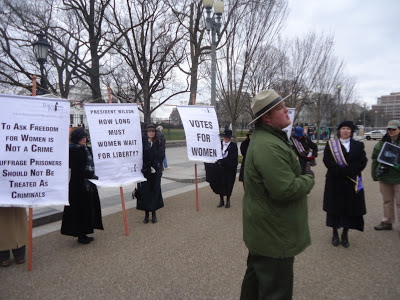
On March 2, 2013, a National Park Service Ranger tells
how the National Woman's Party met in 2017 with Pres.
Wilson to ask for support of Votes for Women, in the
name of Inez Milholland Boissevain, who died in Nov.
1916. Wilson ridiculed the women. Photo by JT Marlin. 
Back Story: Black Sorority Excluded. During the weeks before the parade, the participation of  black women in general was a thorny issue for Alice Paul. Later in life, she described this issue as her main preoccupation at the time.

To be specific, a new breakaway sorority at Howard University, Delta Sigma Theta, demanded that it have a place in the parade. The Alpha Kappa Alpha sorority's leadership at Howard University had decided to break away from the socially ambitious club to form a new sorority that would be more socially activist.

These 22 Delta women wanted to march in the NAWSA parade. Alice Paul feared that participation by black women in still-segregated Washington would end the participation in the parade of the southern chapters of NAWSA and destroy NAWSA's unity.

Alice Paul was in charge of the "Congressional Committee" of NAWSA in 1912 after working for the British suffragettes. She started recruiting new people and raising money, much of it in New York City where NAWSA was then based. She tried to hold together the fragile coalition for a Federal Amendment for Votes for Women.

Inez Milholland disagreed on excluding the black sorority. She was the daughter of the first Treasurer of the NAACP, John E. Milholland, a Scotch-Irish Presbyterian who clung to the Lincoln Republican ethos of supporting equality among the races. She was adamant that the Deltas should be given their place, and allowed to march, in the parade lineup. She threatened to withdraw her commitment to lead the Washington parade on horseback. She had led the New York suffrage parade on horseback to great applause in New York City – it was a media attraction. She was also well connected with NAWSA supporters like Alva Belmont in New York City.

Alice Paul grudgingly agreed to allow the Howard University Deltas to join the parade. But she also had a plan, which appears not to have been shared with Inez Milholland, to minimize the danger to the parade by putting all the black women at the end of the parade, after the Men's League for Woman Suffrage.

It may be hard for some to appreciate how low the status of black women was in the Washington 100 years ago – or how threatened some white people were by signs of electoral activism. The outcome of the Civil War was to enfranchise black men. But the federal law was undermined by Jim Crow laws passed in southern states designed to suppress the black vote as well as the votes of some less-educated white men. For advocates of Votes for Women, seeing black women marching in a parade would remind southerners that adding women voters would double the number of potential black voters.

Contemporary accounts say that Alice Paul and the Congressional Committee leadership were  worried that a visible black presence in the parade would set back progress toward a federal amendment. They may have foreseen that including black women in the parade would add to the potential for the violent reaction that actually occurred. Suffragist Mary Church Terrell reported that the Delta marchers were required to assemble in a segregated area. It was her opinion that:
If [Paul] and other white suffragist leaders could get the Anthony Amendment through without enfranchising African American women, they would do so.
Linda Lumsden's biography of Inez Milholland makes clear that however much Inez may have gone along with excluding blacks in other social contexts, she was firm about the participation of the Deltas.  Milholland was, like her father, a member of the NAACP. Citing Mary Church Terrell again, Lumsden says that Milholland insisted that the Howard contingent be allowed to march in the college section. Emmett Scott, secretary-treasurer of Howard University, said that Milholland
was unwilling to participate in a parade symbolizing a movement which was not big enough or broad enough to live up to the principles for which it was contending. (Lumsden, Inez, p. 91.)
On the day of the parade, Ida B. Wells-Barnett, a former slave who had become a leading suffragist, defied the ruling of the Congressional Committee and marched with her Chicago NAWSA delegation. Others followed suit. In the end, 22 women marched in the Delta contingent and an unknown number of black NAWSA delegates marched with their geographical groups. But the only black organization to march as a group in the parade was the Howard delegation of Deltas! If 250 black women altogether were in the march – probably too high an estimate – and we use the lower NY Times estimate of the number of marchers, it means black marchers were at most 5 percent of the total.

The Deltas listen to their leaders talk about the Deltas' mission,
 "public service" and "social activism." Photo by JT Marlin.
The 2013 March Reversed the Racial Balance. The March 3, 2013 march was a totally different affair. This time, the newly born, tiny Deltas were now the main organizer of the event. They have grown into an army of 300,000 black women world-wide.

For the 100th anniversary march, Delta Sigma Theta reported 20,000 marchers signed up to be in Washington for the parade. The National Park Service posted a crowd estimate of 20,000-25,000.

My estimate is that fewer than 1,000 of the marchers were white men and women. The racial percentages were therefore exactly reversed. In 1913, at most 5 percent of the marchers were black. In 2013, at most 5 percent were white.

Looking Forward, Not Back. Another major difference in 2013 is in the nature of the participation of the Deltas and the other women's groups.
  • The traditional women's groups, mostly white women, were commemorating the actions of the suffragists to obtain the vote. They dressed up in the costumes of 1913 with purple, gold and white sashes and dresses. Although the picketing of the White House did not start until January 1917, the Turning Point Suffragist Memorial group had an effective tableau in place on March 2, 2013 showing the Silent Sentinels in front of the White House. When the demonstrators were arrested by the DC Police, Inez Milholland's sister Vida was one of those arrested, on July 4, 1917. They were taken away to the Occaquam workhouse in Lorton, Va., as described by a National Park Service Ranger who gave the history of woman suffrage in the United States while engaging the audience in some effective role playing (see second photo above).
  • For the Deltas, the parade was less about history and pageantry and more about the next phase of the women's movement. Those Deltas marched with a purpose, every one of them dressed in their red and white colors, and the speeches in front of the Capitol (see bottom photo) were about moving on to new challenges, using their vote to attack continuing abuse of women in the home or in the workplace.
Meaning of the 2013 Parade. The 2013 Centennial parade was scheduled to start at 9:30 am on Sunday but by the time the Deltas who had assembled at the foot of the Capitol were emptied out and other groups started to march it was 10:45 am. The women's groups were there, some in suffragist costume. The traditional women's groups were relatively few in number, several dozen each at most from the League of Women Voters (successor to NAWSA), the National Woman's Party/Sewall-Belmont House and Museum (successor to the breakaway Congressional Committee of NAWSA), the National Organization of Women, the Turning Point Suffragist Memorial Committee and ERA of New Jersey.

There was no rioting – far from it! It was an eerily quiet Sunday morning. The Deltas are all business. They didn't bring any marching bands, which explains why the crowds were thin. Since Washington, DC workers now mostly live in suburban Maryland and Virginia, there were few onlookers, maybe 5,000 at most. Protest marches in Washington are now a regular occurrence. The Deltas were in D.C. in January and will be back in a couple of months.

Inez Milholland's insistence that the Deltas be allowed to march took on more significance for me as I watched an hour-long parade of the sorority's many chapters go by. Inez knew which way the winds were blowing. For the Deltas in 2013:
  • The purpose of most of the marchers, and the meaning of the event, was not so much a memorial to the achievements of yesterday.
  • Rather, it was a reaffirmation of what the original marchers believed in. Progress has been achieved – that is obvious – since the first parade. But the Deltas marched not so much out of reverence for the past as out of determination to meet the challenges of today and tomorrow.
[I have written a longer post putting the two marches in a more complete historical context. I have long been fascinated by the story because Inez Milholland married my mother's uncle, Eugen Boissevain.]

Thursday, February 28, 2013

INEZ | Famed Parade Leader Forgotten

This iconic poster is based on the painting that
hangs in the lobby of the Sewall-Belmont
House in Washington next the Hart Senate
Office Building, was above the mantelpiece. 
February 28, 1913–The Washington Post yesterday, has a story on Inez Milholland from the perspective of the great contrast between her huge contemporary fame and the memory of her contribution to woman suffrage. 

Inez, Suffragette

The story is well told by Lonnae O'Neal Parker, who correctly calls Inez a "suffragette". 

Among the comments (28 when I last looked, several of them mine), one said "suffragette" was the wrong word and "suffragist" was correct. But in fact "suffragette" was not a word that either Inez or Alice Paul shrunk from. It connotes a willingness to be active ("in your face" we might say today) in pursuit of Votes for Women.

Inez trained with the self-styled Pankhurst suffragettes in England, when her father John E. Milholland had a house in London while he tried to get business for his pneumatic tubes from the British Post Office. Alice Paul was also with the suffragettes in London when she was recruited to take over NAWSA's then-moribund Congressional Committee.

The suffragettes were not embarrassed by standing on street corners and shouting "Votes for Women." Dignified ladies preferred to work behind the scenes, but the suffragettes said they had waited long enough for this low-profile approach to bear fruit. They took to the streets.

The parade in Washington was organized by the Alice-Paul-run Congressional Committee of the National American Woman Suffrage Association (NAWSA). The Committee later broke away from NAWSA and became the independent National Woman's Party. 

Both groups played a part in obtaining votes for women and hostility between the groups is unfortunate and unnecessary.

The long-term lobbying of NAWSA was important, but the chain of causation that led to final passage of the 19th Amendment can only be traced via the National Woman's Party. 

The parade 100 years ago is what emboldened the radicals to break off and pursue their own attention-getting campaign. Google "Inez Milholland Boissevain" (her married name) and for a "forgotten woman" you will find a lot of gigabytes of information about her.

No Memorial to Inez

One of the commenters said that there should be a statue to Inez Milholland in Washington. Several people thought this was a great idea. It could be located in one of the squares along Massachusetts Avenue west of the Capitol, where it crosses the grid.

Stanton Square is the other direction, a few blocks east of the Capitol. The square itself is named after Edwin Stanton, Secretary of War during the Civil War. Maybe no one would object if the name of the square was shared between him and Elizabeth Cady Stanton. The square was the location of the first campaign headquarters of two-term President Barack Obama.

The statue in Stanton Square is not of Stanton but rather of Nathanael Greene, a soldier in George Washington's army after whom is named Greensboro, NC–birthplace of Rep. Carolyn Maloney (D-NY). 

It is in good condition, i.e., not a candidate for rider replacement. But maybe the National Park Service could come up with a candidate for redeploying one of the many handsome warhorse statues in Washington, DC. They would need to find one where the horse is solid but the rider is worn out by rain, or is by a mediocre sculptor and does not have a family or an institution to object vociferously to replacing the rider.

Iron-Jawed Angels

Another commenter on the Washington Post story recommends the movie Iron-Jawed Angels, wthe première of which I saw in Philadelphia. It tells the 19th Amendment story from Alice Paul's point of view. Alice Paul was a behind-the-scenes organizer, and a good one. She knew that Inez Milholland was the perfect woman to put in front of the public as the figurehead of the parade of the National Woman's Party. Inez would capture the affection of both men and women. Inez was happy to play that role.

But when Inez got sick in 1916 on her national campaign with her sister Vida, she should have stopped. Instead, spurred on by Alice Paul, she carried on until her collapse and death. In the movie, Paul is stricken with remorse.

We need another movie, from the perspective of Inez Milholland and the inspiration she was for the rest of the woman's movement. It would be a more interesting movie! In Iron-Jawed Angels (2004), Inez was played by Julia Ormond, who was then 39, nine years older than Hilary Swank, who played Alice Paul. Actually, Inez was younger than Alice Paul, not to mention rated "the fairest of the Amazons" by The New York Times editors, who normally don't get into rating the fairness of women.

Picketing the White House 

The picketing of the White House in 1917, started because President Wilson dissed a delegation of women from the National Woman's Party who appealed to him with 250 memorials of inez Milholland Boissevain's death. The emotional reaction is hard to understand unless you appreciate the contrast between the affection people had for Inez and the President's ivory-tower lecture to the delegation on its ignorance of political reality.

The National Woman's Party was then across Lafayette Park. The angry, fuming women left the White House and immediately started picketing in front of the White House gates, calling themselves the Silent Sentinels. The ignorance of political reality was more on the President's side than on the side of the National Woman's Party.

This phase is called the Turning Point by the Turning Point Suffrage Memorial group, which wants to create a memorial to the suffragists at the Workhouse (prison) in Lorton, Virginia, where the women were brought when President Wilson signaled his impatience with the picketing. In prison, the women - including Inez's sister Vida Milholland - went on a hunger strike and were force-fed, and that is when the tide of public opinion turned in favor of the suffragists. In changing his mind, Wilson referred to the good work of women in the war effort, but when the 19th Amendment was passed the New York Times gave credit both to the good ladies of NAWSA and the more radical women (young and old) of the NWP, giving one the silver pen and the other the gold inkstand.

Remembering the 1913 Parade, 100 Years Later


The parade on Sunday is sponsored by Delta Sigma Theta, a black sorority at Howard University. Back in 1913, when they asked the National Woman's Party if they could be in the parade, the initial response was that it would be awkward because the southern membership of NAWSA would be upset. 

Inez Milholland got wind of this and talked to Alice Paul about it and the sorority was allowed to march, but they were put safely towards the back of the parade. The National Woman's Party became very brave by 1917 but in 1913 they were just the Congressional Committee of NAWSA, which itself was a merger of two suffrage groups (NWSA and AWSA, if I remember correctly) that had split over tactics when it appeared that non-white men would be added to the electorate before white women. Former slave Frederick Douglass was a key advocate in 1848 for the first Women's Convention to go for votes for women. But when during the Civil War it came to a choice between enfranchising black men or white women, he could only go one way.

Wednesday, February 27, 2013

INEZ | Her Herald Uniform 1913 (Update Aug. 5, 2016)

1. Alice Paul's idea of Inez Milholland's
1913 costume as the Herald. The trumpet
was a non-starter; hard to handle that and
the horse at the same time.
The Woman Suffrage "Procession" was scheduled on the eve of Woodrow Wilson's first inauguration, on March 2, 1913.

Alice Paul, on behalf of the newly formed Congressional Committee of the National American Woman Suffrage Association (NAWSA), asked Inez to lead the parade.

The Congressional Committee the following month, emboldened by the success of the parade, became the Congressional Union. In 1916 this entity, with significant new funding, became the National Woman's Party.

Alice Paul asked Inez to be a Herald and wear a uniform emblazoned with the three colors of the suffrage movement – gold, white and purple (in heraldic lingo – or, argent and purpure).

These are the colors that Inez is shown wearing on the flyers about the parade.

2. Inez Milholland on "Gray Dawn" (loaned by
Mr. A. D. Addison of Washington) at the
start of the parade. Photo: Library of Congress.
But Inez decided that an all-white–or, in The New York Times account, a pale blue–cloak looked better. Alice Paul was unhappy about it, but what could she do?

The white uniform was a success. The day after the parade, the N Y Times story devoted its early paragraphs to Inez's striking appearance at the head of the parade.

Later in the story, we are told that the event was marred by violence – the D.C. police were unable or unwilling to keep order, and cavalry from Fort Myer, Va. had to be brought in to keep the peace.

The Washington Post called Inez "the most beautiful suffragette" (this source also has a great collection of postcard photos of the parade).

What do you think? Photos of the actual event show Inez like a clothed Lady Godiva – white gown on a white horse.
The iconic poster of Inez, 1923 for the
 "Forward into Light" pageant at
Meadowmount, Lewis, N.Y.

One of those photos served as the image used to create the iconic posthumous portrait of Inez on a horse. For decades until 2011 it hung over the mantelpiece in the Sewall-Belmont House, now renamed the Belmont-Paul National Monument,  in Washington. (The mantelpiece was removed because of chimney leaks.)

The iconic painting was in bad condition and was carefully restored with the assistance of a Committee headed by Al Boissevain and Allegra Milholland.

The poster made from the painting inspired the National Woman's Party picketers and hunger strikers.

When Inez was married in July 1913, the New York Times expressed regret that a Hollander with a French name (Boissevain) had nabbed Milholland, the daughter of a Scotch Irish man (the family name Milholland is an Anglo-Irish transliteration of a Gaelic word meaning Follower of St. Chulann).

The Times described Inez as "the Fairest of the Amazons".

Related Posts: Suffrage Play June 11, 2017 in Vienna, Va.
Inez Milholland's Faceted Star Crown-Helmet, 1911

5A. Washington Centennial [12]

Several Washington-based women's groups are sponsoring a 100th anniversary of the suffrage parade that greeted Woodrow Wilson on the even of his inauguration. He refused to support Votes for Women (the Anthony Amendment) and the parade was intended to promote his support. All of this is posted on the website www.boissevain.us/inezmilholland.

The events in Washington start on February 28 (Thursday - tomorrow) and go through Sunday, when the parade is re-enacted. I plan to be there on February 28, March 2 and March 3. I must be in NYC on March 1. I can be reached by email at teppermarlin@aol.com.


memory.loc.gov › American MemoryShare
Suffrage Parade 3/3/13 [Inez Milholland Boissevain]. ... Soon, however, the crowds, mostly men in town for the following day's inauguration of Woodrow Wilson, ....American Woman Suffrage Association paradeWashington, D.C., March 3, ...

The Suffrage Centennial Celebration in Washington will re-enact the parade of 5,000 suffragists, who braved 500,000 onlookers, including many hostile and physically violent men, on March 3, 1913, with a single public demand, the right to vote! The Celebration begins Thursday, February 28 and continues through March 3.

The weekend events include exhibits, speakers, panels, movies, special programs. See historic places and treasures found only in the nation’s capital including the 19thAmendment to the U.S. Constituent at the National Archives and the Sewall-Belmont House & Museum, the historic headquarters of the National Woman’s Party.

See suffragists picket the White House once more at noontime - 10 am to 2 pm (the picketing was launched in 1917, immediately after a group of NWP women went to President Wilson with memorials on the death of Inez Milholland two months before.  Wilson ridiculed their lack of political savvy and that provoked a backlash. At that time the National Woman's Party was located across Lafayette Square from the White House, so they went back to HQ and decided to turn around and start picketing until Wilson agreed to support suffrage. That picketing led to arrests, then imprisonment, then a hunger strike. Public opinion shifted and Wilson changed his mind (as he did on the other major issue of 1916, going to war with Germany). The Congress passed the 19th Amendment, Wilson signed it, and it was ratified by the last required state in 1920. This ended a 72-year struggle (dating from the Seneca Falls Convention) by three generations and millions of women. 


Come honor and learn about the women behind the historic victory that gave women the power to vote.  See  
www.suffrage-centennial.org for complete information and details.  Join the parade-- -Suffrage Centennial March  down Pennsylvania Avenue on Sunday at 9:00 am. Register at: http://nwhm.ticketleap.com/join-the-parade/

Google "Inez Milholland" and you will find many of my blogposts on this great woman, one of the American  Heroines of the 20th century. Or go to www.boissevain.us and click on "Inez Milholland".

Here is a synoptic view of the events (exhibits not included) of the weekend. It is meant for volunteers, but it will tell you what the main events are, how long they will take, and where they take place.
Date
Event
Meeting Place for Volunteers
Thurs, February 28th
5:15 pm to 7,
party over by 9
Silent Sentinels at NPC
National Press Club ("NPC")
529 14th Street NW
Meet in street level lobby of office building
TPSM Board at NPC
Go to cocktail party on 13th floor
Fri.March 1st 
 5:15 pm to
6:30 pm
Embassy of Finland
NEC of 34th Street and Mass Avenue NW
Embassy is 3301 Mass Avenue NW
Sat. March 2nd
8:30 am
To 5:15 pm
Table at AAUW
AAUW lobby
1111 16th Street NW (NEC 16th and L Streets)
March 2nd 9:30 am
To 2 pm
White House with NPC
White House Gates
160 Pennsylvania Avenue NW
Sunday March 3rd 8:30 am
Till noon??
Parade
U.S. Botanic Gardens  -  at the main sign/entrance
100 Maryland Avenue SW
Near Reflecting Pond and Russell House Bldg.
Near 1st and Independence Avenue SW
Parade starting point is West Lawn of Capitol