Showing posts with label Wesleyan Chapel. Show all posts

Sunday, July 19, 2020

SENECA FALLS | Convention Opened July 19, 1848

Lucretia Mott
July 19, 2020—This day in 1848 the Seneca Falls Convention opened, the first Convention on Women's Rights.

When the organizers of the convention (Elizabeth Cady Stanton and others) arrived at the Wesleyan Church in Seneca Falls, New York before the event that morning, they found:
  • A small crowd of women already waiting. The church was locked. Someone helped Stanton's nephew through a window, and he unlocked the church.
  • Men, who had been invited only to the second day of the conference.
The women decided to let the men stay, provided they held off talking until the second day.

One of the men who was waiting was former slave and abolitionist Frederick Douglass. He had run an announcement of the event in his Rochester-based paper, The North Star.

The five Convention organizers (Lucretia Mott and three other Quakers, plus Elizabeth Cady Stanton) had drafted started drafting a women's Declaration of Independence,  starting "All men and women are created equal." Stanton took the document home with her and drafted what she called a Declaration of Sentiments with "injuries and usurpations on the part of man toward woman" and 11 resolutions calling for religious, economic and political equality. The ninth resolution called for women to be given the vote.

Mott was not in favor of this. She feared it went too far. "Lizzie," she said, "thee will make us ridiculous."

Stanton held firm, and the resolution stayed in. Stanton took the podium for the evening session, and she compellingly placed the struggle for women's rights in the tradition of the other reforms like the temperance and anti-slavery movements.

Frederick Douglass was the only African American person attending. He spoke up, saying, "In this denial of the right to participate in government, not merely the degradation of woman and the perpetuation of a great injustice happens, but the maiming and repudiation of one-half of the moral and intellectual power of the government of the world."

His comments were part of the suffrage play that I wrote that was featured at an event in Vienna, Virginia sponsored by the Turning Point Suffrage Memorial in 2017.

Eventually, one hundred people signed the Declaration of Sentiments.

Elizabeth Cady Stanton wrote in her diary, many years later: "We are sowing winter wheat which the coming spring will see sprout and which other hands than ours will reap and enjoy."

It would be 72 years before women would be granted the right to vote––and effectively, it was only white women who were effectively granted that privilege, because of state laws that restricted voting by African Americans.

Only one of the signers of the original Declaration of Sentiments was still living in 1920. Charlotte Woodward, who had been 19 and working in a glove factory in 1848, was too ill to vote.

Sunday, August 21, 2016

VOTES FOR WOMEN | July 19–Seneca Falls Convention

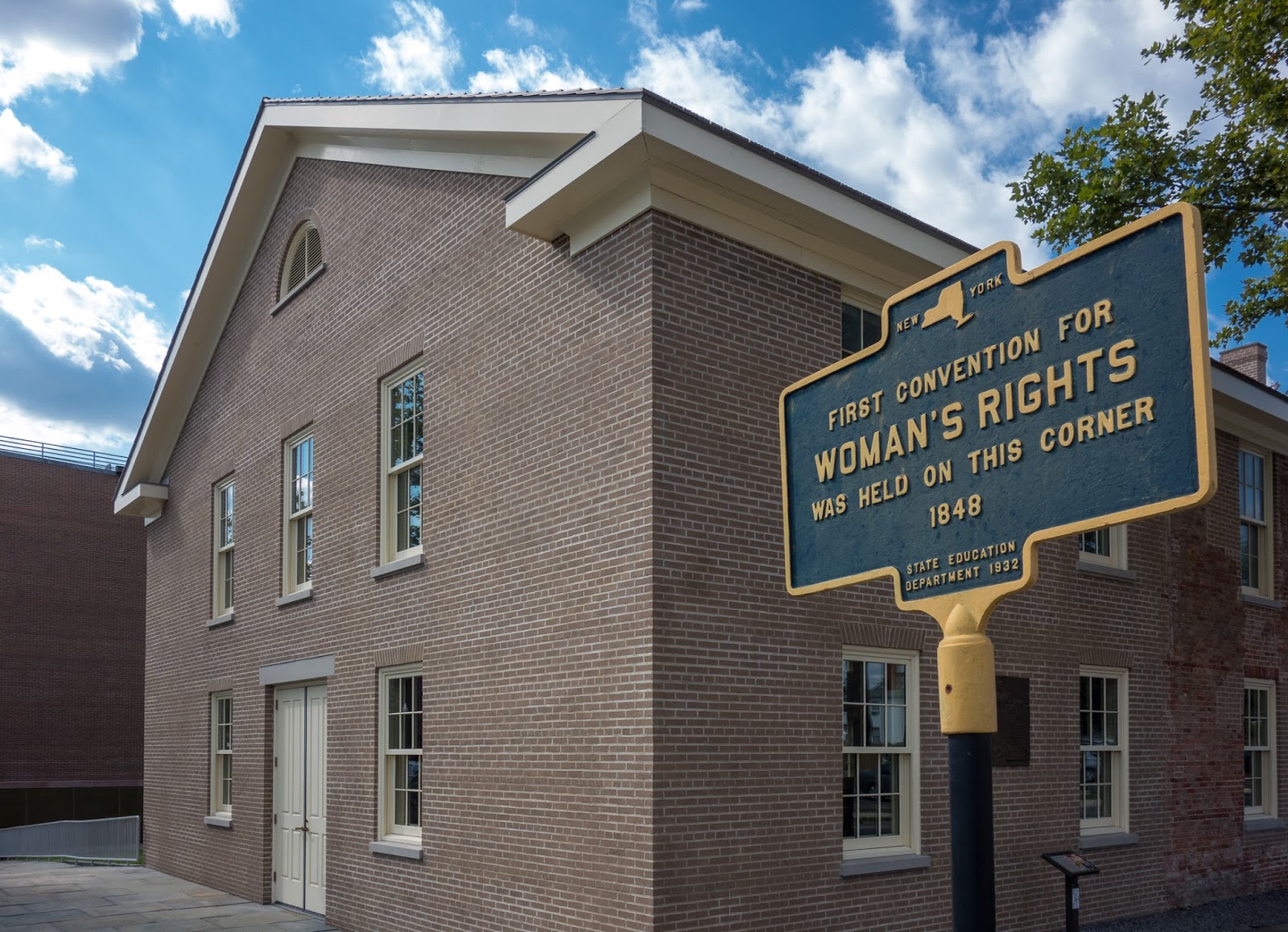
Site of Wesleyan Chapel, Seneca Falls.
At the Wesleyan Chapel in Seneca Falls, N.Y., a woman’s rights convention–the first ever held in the United States–convened in 1848 with almost 200 women in attendance.

Why It Was Organized

The convention was initiated by Quaker Lucretia Mott and Elizabeth Cady Stanton, previously united in opposition to slavery.

They first met at the 1840 World Anti-Slavery Convention in London. Even though Mott was a full delegate, both Mott and Stanton were barred from the convention floor because they were women. Their anger flared and then simmered for eight years.

When Mott visited Stanton in 1848, they arranged for a tea at the home of Mary Ann McClintock. Also attending were Martha Wright and Jane Hunt. Together the group decided to advertise (on July 14 in the Seneca County Courier) a women’s conference to be held at the Wesleyan Chapel in Seneca Falls. The announcement read:
A Convention to discuss the social, civil, and religious condition and rights of women will be held in the Wesleyan Chapel, at Seneca Falls, N.Y., on Wednesday and Thursday, the 19th and 20th of July current; commencing at 10 o’clock A.M. During the first day the meeting will be exclusively for women, who are earnestly invited to attend. The public generally are invited to be present on the second day, when Lucretia Mott, of Philadelphia, and other ladies and gentlemen, will address the Convention. 
What Happened

On July 19, 200 women and some men convened at the Chapel, and Stanton read the “Declaration of Sentiments and Grievances,” which she had drafted over the previous few days, modeled on the American Declaration of Independence, which in turn is widely believed to have been modeled on the 1320 Scottish Declaration of Arbroath. The preamble of Stanton's Declaration began:
We hold these truths to be self-evident: that all men and women are created equal; that they are endowed by their Creator with certain inalienable rights… 
The Declaration of Sentiments and Grievances detailed injustices to U.S. women and called upon women to petition for their rights. The men who attended the first day, even though they were only invited for the second day, were allowed to stay. One of them spoke–Frederick Douglass, who urged the women to introduce the suffrage demand.  Stanton favored it, but Mott was opposed.

On the second day the Declaration of Sentiments and Grievances was adopted and signed by the assembly. The convention also passed 12 resolutions–11 unanimously–which called for specific equal rights for women. The ninth resolution, on suffrage (“It is the duty of the women of this country to secure to themselves their sacred right to the elective franchise”) was the one of the 12 that was passed over opposing arguments.

The Seneca Falls Convention was followed two weeks later by a larger meeting in Rochester, N.Y. After 72 years, the 19th Amendment was adopted in 1920, recognizing the Federal rights of American adult women to vote.

Related Posts

Inez Milholland—Herald Uniform . Her Engagement to Marconi . Short Biopic on Her