Showing posts with label New York. Show all posts

Sunday, July 19, 2020

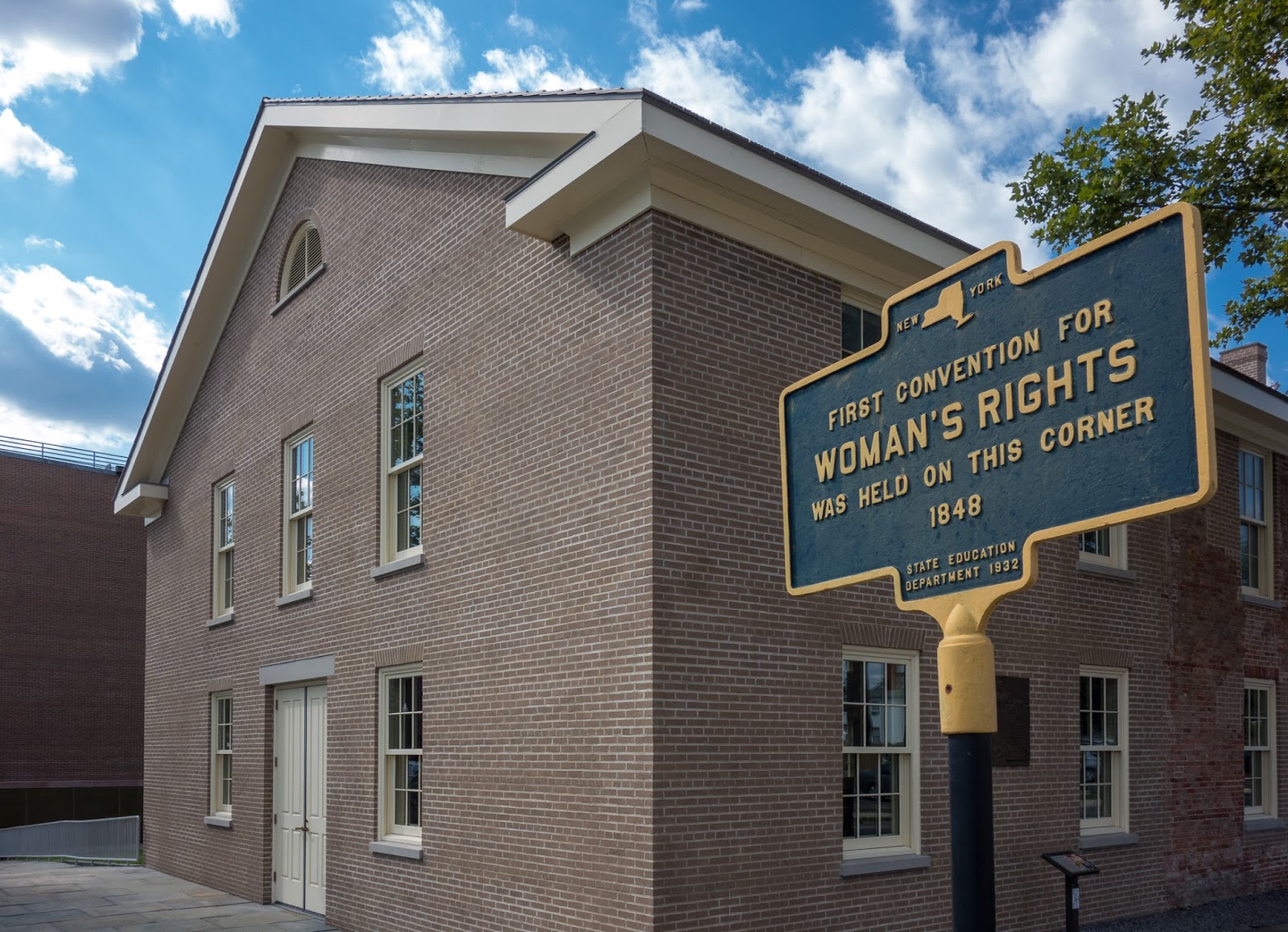
SENECA FALLS | Convention Opened July 19, 1848

Lucretia Mott
July 19, 2020—This day in 1848 the Seneca Falls Convention opened, the first Convention on Women's Rights.

When the organizers of the convention (Elizabeth Cady Stanton and others) arrived at the Wesleyan Church in Seneca Falls, New York before the event that morning, they found:
  • A small crowd of women already waiting. The church was locked. Someone helped Stanton's nephew through a window, and he unlocked the church.
  • Men, who had been invited only to the second day of the conference.
The women decided to let the men stay, provided they held off talking until the second day.

One of the men who was waiting was former slave and abolitionist Frederick Douglass. He had run an announcement of the event in his Rochester-based paper, The North Star.

The five Convention organizers (Lucretia Mott and three other Quakers, plus Elizabeth Cady Stanton) had drafted started drafting a women's Declaration of Independence,  starting "All men and women are created equal." Stanton took the document home with her and drafted what she called a Declaration of Sentiments with "injuries and usurpations on the part of man toward woman" and 11 resolutions calling for religious, economic and political equality. The ninth resolution called for women to be given the vote.

Mott was not in favor of this. She feared it went too far. "Lizzie," she said, "thee will make us ridiculous."

Stanton held firm, and the resolution stayed in. Stanton took the podium for the evening session, and she compellingly placed the struggle for women's rights in the tradition of the other reforms like the temperance and anti-slavery movements.

Frederick Douglass was the only African American person attending. He spoke up, saying, "In this denial of the right to participate in government, not merely the degradation of woman and the perpetuation of a great injustice happens, but the maiming and repudiation of one-half of the moral and intellectual power of the government of the world."

His comments were part of the suffrage play that I wrote that was featured at an event in Vienna, Virginia sponsored by the Turning Point Suffrage Memorial in 2017.

Eventually, one hundred people signed the Declaration of Sentiments.

Elizabeth Cady Stanton wrote in her diary, many years later: "We are sowing winter wheat which the coming spring will see sprout and which other hands than ours will reap and enjoy."

It would be 72 years before women would be granted the right to vote––and effectively, it was only white women who were effectively granted that privilege, because of state laws that restricted voting by African Americans.

Only one of the signers of the original Declaration of Sentiments was still living in 1920. Charlotte Woodward, who had been 19 and working in a glove factory in 1848, was too ill to vote.

Tuesday, February 4, 2020

BIRTH | Betty Friedan, February 4

Betty Friedan, 1921-2006
February 4, 2020 – This day was born feminist Betty Friedan, in Peoria, Illinois, in 1921, the year after the passage of the 19th amendment including women among the enfranchised. (Next year will be the 100th anniversary of her death.)

She was not popular in high school, being unconventional in looks and behavior. She was smart, though, and excelled at Smith.

After marrying and having a conventional suburban life, she surveyed her Smith peers at their 15th reunion and found a lot of discontent among them, which she called  "the problem that has no name." She wrote a book about this, about the myth that women were expected to find fulfillment in domestic lives as mothers and wives. Her name for the myth became a book, The Feminine Mystique (1963).

It was a best-seller, and helped kick off the "second wave" of feminism, the "first wave" being women's suffrage, which would have to be a long ("Kondratieff") wave since it lasted from 1848 to 2020. She marched with Gloria Steinem in 1970 in New York City to celebrate the 50th anniversary of the recognition of the right of women to vote. This year is the 100th anniversary; Friedan would have been 99 years old.

Betty Friedan lived in Sag Harbor, N.Y. during the summers. She spoke at a NY City Hall performance in 1995 of my suffrage play, "Take Up the Song," and again at a performance at the Springs Church. I remember picking her up at her home and dropping her off again and being impressed with her edgy take on current events. She died the same year as my mother, 2006.

Sunday, January 19, 2020

INEZ | News about Inez from Lewis, N.Y

Inez Milholland near the U.S. Treasury at the end of
the Suffrage March in March 1913. Long forgotten, she
 is being remembered well in 2020.
We just received an update from Sandra Weber, who helped produce a version of my 1998 play, "Forward into Light", at the Lewis Church, where Inez Milholland Boissevain is buried.

Sandra's email to a few Inez fans is posted below, with her permission. I have added some links to her references to save time for readers:
Words cannot express my gratitude to all of you for your efforts towards bringing Inez into the Light. Your years of campaigning and promoting have come together into a glorious force of recognition in the past year, and especially the past few weeks. I am filled with such joy and inspiration and hope for the future.
I would like to share with you a few planned and unplanned events I have witnessed in the recent days. Yesterday, at the Adirondack Women’s March at the grave of Inez, we celebrated the life and legacy of Inez, particularly the official naming of Mount Inez. Thank you, Nancy Duff Campbell. And, Molly from Adirondack Explorer is creating a short documentary about the naming of Mount Inez.
We unveiled the placing of an Inez challenge coin (sponsored by the Champlain Valley National Heritage Partnership) at the entrance to the Milholland gravesite. And we celebrated Alice Paul, and Virginia’s ratification of the ERA.
On Wednesday evening, January 15, I attended the creation of an Inez mosaic at the Keene Central School. This was a project of the Art Force 5 of Alfred University, which is doing an amazing job of promoting women in history. And they created an Inez T-shirt, too.
And, Martha Wheelock, they played your Forward Into Light documentary [financed by as a kickstarter project] during the creation of the mosaic. I expect you will be receiving many requests for your DVD. This is only the first month of 2020–and look at the momentum already created.
Last year I led an Inez tour for Adirondack Architectural Heritage and will repeat this year, along with an Inez lecture at the Adirondack Experience Cabin Fever Series on February 9. I am also part of a group planning a Champlain Valley Centennial Suffrage Auto Tour which includes events honoring Inez Milholland, including a celebration of her birthday (tentatively scheduled for August 2). Links and photos of the mosaic project, the coin, the Women’s March, and Mount Inez are at Adirondack Women’s March website [link is above].
Jane Barker, then Chair of the Turning Point Suffrage Memorial,
with the restored portrait of Inez Milholland, which long hung
over the fireplace of the National Woman's Party HQ in
Washington, DC. (Photo by JT Marlin, 2016.)
I could also add the Roadside Marker that was placed in 2017 to recognize this famed favorite daughter.

Also the Turning Point Suffrage Memorial planned for Lorton, Virginia, which raised  $40,000 in 2017 with another version of my play at the Vienna Country Club in Vienna, Virginia.

Also the move for women's statues in Central Park (Inez was one of ten New York Times nominees).

Also the raising of $4,000 to restore the National Woman's Party portrait of Inez Milholland Boissevain. (See photo at right of Jane Barker in 2016, at the celebration of the completion of the portrait's restoration).

Please send any other news about Inez to teppermarlin at aol dot com, or any links I have missed, and your blogger will post here as a compendium of Ineziana.

Wednesday, October 9, 2019

MOUNT INEZ | Town of Lewis Follows Up, A Century Later


From the Elizabethtown Post,
December 7, 1916.
October 9, 2019–Yesterday evening, the Lewis (Essex County, NY) Town Council voted to rename Mount Discovery. The new name is "Mount Inez".

The mountain is named after Inez Milholland Boissevain (1886-1916), who spent her childhood and summers here and is buried on a hill in the graveyard behind the Lewis church.

This is the fulfillment of a name change made after Inez's  death in 1916, by the then-owner of the property, John E. Milholland, her father.

The commitment was at that time apparently formalized by the then government of the Town of Lewis. It was announced in the Elizabethtown Post on December 7, 1916, and was featured on the front page of the New York Times a few days later.

However, the name change was not forwarded to and memorialized by the U.S. Board on Geographic Names (USBGN), part of the U.S. Department of the Interior, or the New York State Board on Geographic Names.

Through diligent work by Nancy Duff Campbell, a century later this error was yesterday rectified as a vote was taken by the Lewis Town Council in favor of the name change. Your blogger sent the following letter to the Lewis Town Council in advance of the meeting, and to the USBGN. That evening, the Lewis Town Board formally approved the name change. The last stop in the process will be at the USBGN.
October 8, 2019 
To the Lewis Town Council, Lewis, NY 
Dear Supervisor Monty and the Lewis Town Council, 
This is to support renaming Mt. Discovery as Mt. Inez. 
I am a huge fan of Inez Milholland. She was married to the brother, Dutchman Eugen Boissevain of my grandmother (Olga Boissevain). My mother met Inez when Inez was first married in 1913 and the couple went to visit Eugen's relatives in Holland. My mother described Inez to me in great detail, how sweet-smelling she was and how she brought with her a gift of a Kewpie Doll (the doll with little wings in the back), which was the rage at the time. 
Inez proposed to Eugen on the Cunard ship Mauretania and they were married in the Kensington Town Hall in London on Bastille Day 1913. The idea was they wanted to go to Holland as a married couple, not just engaged. They were going to keep it a secret from Inez's father, John Milholland. By this time Inez was already a national figure, having led the suffrage parades in New York and Washington, DC. She was also well known in London as a disciple of the Pankhursts (she was proud to call herself a Suffragette, as the Pankhurst followers did, not just a suffragist). 
So the attempt to keep the wedding a secret was futile. It was featured on the front page of all the newspapers and that's where John E. Milholland read about it in the New York Times the next day. He wanted Inez to marry Guglielmo Marconi, the radio guy, who actually proposed to Inez on another Cunard ship when Inez was not yet in college. Inez accepted, but Marconi's Irish mother (a cousin of Eugen's Irish mother) was distressed that Inez would go to the United States and talked her son out of it. Inez later said she loved the radio but didn't want to marry it. 
In an effort to keep the memory of Inez memory alive, I wrote a play about her that was produced as a staged reading in the Lewis church where she is buried (it was also staged in six other locations). I maintain a website about her, www.inezmb.blogspot.com. I was the secretary and organizer of a national committee to pay for the restoration of the iconic painting of Inez that hangs in the Belmont-Paul building next to the Hart Senate Office Building in Washington (https://www.adirondackalmanack.com/2010/04/inez-milholland-portrait-restoration-planned.html. The Committee was headed by  members of the Boissevain (especially Al Boissevain, Eugen's nephew) and Milholland families and included Margaret Gibbs of the Essex County Historical Society. The painting was restored to the highest standards. 
A century ago, the Lewis Town Council reportedly decided to rename the mountain. It's not too late to make good on the promise. The world owns the memory of Inez Milholland, but only Lewis owns her gravesite and the mountain that your predecessors in office promised to rename in her honor. As the logline of a recent movie, "The Silent Soldier and the Portrait," puts it, "If the Universe offers you a second chance, take it."
John
John Tepper Marlin, Ph.D. (teppermarlin at aol dot com)

Monday, March 12, 2018

ANTHONY AND STANTON | Statue Campaign

L to R: Stanton, Anthony, Mott.
March 12, 2018 – Gary Ferdman's birthday is today and he wants you to give money to his campaign to have statues erected in New York City memory of Susan B. Anthony and Elizabeth Cady Stanton.

Elizabeth Cady Stanton was the first of the two to become committed to the Votes for Women cause. Stanton was at the Seneca Falls Convention; Anthony was converted to the cause a couple of years later, although her Rochester-area Quaker family was long committed to the abolitionist movement.

Stanton met Lucretia Mott in London at the 1840 World Anti-Slavery Conference and the were told that women should keep quiet and sit in a special section reserved for non-voting observers. They were outraged, but Lucretia Mott went back to Philadelphia where she was a famed Quaker orator. Stanton had several children in succession and found her life as a mother in Seneca Falls to be difficult.

There is no statue to Stanton or Anthony in New York City. Famously, the statues to women are of ancient Greek or Roman gods, or Mother Goose. Mott, Stanton and Anthony are remembered in a sculpture in the U.S. Capitol building. Edna St Vincent Millay, who married the widower of Inez Milholland, wrote a poem dedicated (in the printed version) to Inez Milholland, which she read out in 1923 at an unveiling of the statue. This is the ending of a play I wrote about Milholland that was read at a fund-raiser in Vienna, Va. in 2017.

Millay and Milholland were both New Yorkers in the sense of New York City dwellers (Milholland was born in Brooklyn and lived there and on Madison Square; Millay became a Greenwich Village aficionado). It would be just as appropriate in due course to have monuments to these great women in the City. Millay was a student at Vassar when Milholland visited the college as an alumna with her husband, my mother's uncle, at Vassar's 50th Anniversary.

I have donated toward the erection of the statues to Stanton and Anthony. My second contribution is this appeal, in addition to the one I posted in 2016. Please give!

Friday, November 24, 2017

INEZ | Her New Roadside Marker in Lewis, NY!


November 24, 2017 – A new marker for Inez Milholland Boissevain has been erected in her childhood home, Lewis, N.Y.

Three cheers for the Pomeroy Foundation for creating this and other physical markers for the women who persevered in campaigning for their right to vote.

The eldest of the three children of John E. Milholland and his wife Jean Torrey Milholland, Inez was born in New York City, in a neighborhood that is now called Brooklyn Heights.

The Lewis newspaper in 1916 supported
changing the name of "Mt Discovery" to
 "Mt Inez". The maps were never changed.
It's not too late to do that.

She spent her summers and other vacations in the huge property that her her father purchased in Lewis, and learned to ride a horse there – a skill that defined the iconic image by which she is best known today.

The mountain on the Milholland property, Mt Discovery, was supposed to have been changed to Mt Inez but the maps haven't reflected the change. It's harder to do that than they thought. The name change would be an even better marker than a roadside sign. Maybe the Pomeroy Foundation can help with that? There are other pointless names in the United States that could be changed to those of neglected American women.

Inez is the only woman in the American suffrage movement who is considered to have given up her life for the cause. She died like a soldier on the battlefield at the age of 30 in 1916, collapsing in October that year while on a grueling speaking tour with her sister Vida, and dying six weeks later in Los Angeles.

I have written a play about Inez. A 15-minute movie about her life was created last year. The connections are being made between the huge ceremony on Christmas Day in her honor and the anger of the  delegation of women to President Wilson the following month that he dissed. 


Buy a large-size durable poster of Inez
 for $30 from Boissevain Books LLC.
The picketing of the White House that started in January 2017 began with the memory of Inez Milholland Boissevain.

This blogsite is filled with recent efforts to recognize her contribition to the gaining of recognition of women's right to vote in New York State and the nation.

Sunday, June 25, 2017

NY SUFFRAGE | Centennial, June-Nov 2017 (Updated Aug 7, 2017)

Historical marker of the home of May Groot
Manson, East Hampton suffragist. Unveiled,
 June 2017.
Women won the right to vote in New York State in November 1917.

That was three years before the 19th Amendment to the Constitution was ratified, giving women the vote in national elections.

Nationally, anti-suffragists warned that when a woman received the right to vote,
''Political gossip would cause her to neglect the home, forget to mend our clothes and burn the biscuits.''
New York State became a pivotal state in the national suffrage campaign. Women who had never dealt with larger units than missionary societies, literary clubs or cake sales were given territory with 16,000 or more voters and ordered to reach every one of these men.

Much of the activity centered on New York City, which was the home of suffragist leaders like Inez Milholland, Crystal Eastman, Harriot Stanton Blatch and Alva Vanderbilt Belmont.

Marker. Photo by JT Marlin, June 25, 2017.
East Hampton in August 1913 was the site of a suffrage rally, starting in front of the home of suffrage leader May Groot Manson on Main Street, across from First Presbyterian Church of East Hampton.

Westchester County was a hotbed of suffrage activists, who enrolled 20,000 women in 102 suffragist clubs. The cause brought Social Register ("Blue Book") women together with women workers in trade unions and homemakers in modest homes to work under a common banner.

Westchester County's four Assembly Districts were led by a suffragist leader — Mrs. Arthur Livermore of Yonkers, Mrs. Leigh French of New Rochelle, Mrs. Marshall Backon of Tarrytown and Adelaide Goan of Katonah. The State League of Women Voters was opened to male members, and men composed about 10 percent of the county group.

New Rochelle was the home of Carrie Chapman Catt, President of the National American Woman's Suffrage Association. Following the state success in passing votes for women in 1917, Mrs. Catt organized the New York State League of Women Voters, saying:
''What are we going to do? We know nothing about politics. We've got the vote. Now we must learn to use it.''
Famed Portrait by Sargent of May
Groot Manson. It was a house gift
 from the painter.
Scarborough was home to Narcissa Cox Vanderlip who became the first president of the Woman's Suffrage party (later called the New York State League of Women Voters). She agreed to organize volunteers to take a "military census" of able-bodied men in the county. She surveyed 320,000 residents and saved taxpayers thousands of dollars. The New York Sun said in 1917:
''One of the common reproaches against suffragettes is that they are not interested in anything but getting the vote. The Woman's Suffrage Party is disproving the accusation.''
White Plains was the site of a project begun by S. J. Russell, a leader of the White Plains suffrage association. In 1914, Russell organized a ''baby-checking'' service to encourage women to exercise the vote they had won in local town and village elections.

SUFFRAGE CENTENNIAL  EVENTS 2017

JUNE

June 29 (Thursday) One Woman, One Vote at the Adirondack History Museum, Lewis, Essex County, N.Y. Lewis is the birthplace of Inez Milholland.


JULY

New Yorker Inez Milholland Boissevain,
well portrayed in a reading of "Take Up
 the Song" at the Westwood  Country Club,
Vienna, Virginia in June. The black-tie
event raised $20,000 for the Turning
Point Suffrage Memorial.
July 4 (Tuesday), 10 a.m. Parade in Southampton. Parade forms at 9 a.m. Wear white, and “Votes for Women” sashes ($10 donation). To sign up, email Judi Roth at rothhandj@ yahoo.com or Arlene Hinkemeyer at ahinkemeyer@ optonline.net.

July 13 (Thursday), 11 a.m. Southampton Historical Museum and Rogers Memorial Library present Natalie Naylor’s PowerPoint talk on “Winning Votes for Women,” about L.I. suffrage leaders. Southampton Historical Museum, 17 Meeting House Lane. Dr. Naylor, a retired Hofstra professor, is president of the Nassau County Historical Society.

July 16 (Sunday). Afternoon Tea, Talk and Tour, celebrating Mary Louise Booth. Yaphank Historical Society, 469 Main Street, Yaphank, NY 11980, (631) 924-0146.

AUGUST 

August 24 (Thursday), 2-4 p.m. Re-creation of August 1913 suffrage rally in East Hampton, starting in front of the home of suffrage leader May Groot Manson on Main Street, across from First Presbyterian Church of East Hampton. Wear white or period dress, “Votes for Women” sashes, and choose to be one of the prominent women/men who marched in 1913 (names recorded in 1917 E.H. Star article). Rally ends with program and refreshments at E.H. Library. Buy your sash for $10 donation, email ahinkemeyer@optonline.net to sign up. Hamptons 100th Anniversary.

OCTOBER

October 19 (Thursday), 6 p.m. East Hampton Library, Tom Twomey Lecture Series, talk by Antonia Petrash and Arlene Hinkemeyer, on Long Island and South Fork suffrage leaders. Moderated by Judith Hope, hosted by Brooke Kroeger. Includes historical exhibit, student presentation, and reception.

October 21 (Saturday), 12 Noon. Rally at the Nassau County Legislative Bldg.

NOVEMBER

November 4 Votes for Women exhibition opens at The New York State Museum in Albany, NY. The six-panel traveling exhibition will be on view at venues throughout NY State: Albany City Hall, Clinton Historical Society, Cortland County Historical Society, Eastville Community Historical Society, Geneva Historical Society, Katonah Village Library, Lorenzo State Historic Site, National Susan B. Anthony Museum & House, New York State Fair, Niagara County Historical Society, The History Center, and the Seneca Falls Historical Society

November 19 (Sunday), 3 p.m. Rogers Memorial Library, Southampton Historical Museum and SAC, a Suffrage Musical Revue!, directed by Valerie di Lorenzo, at Southampton Arts Center, 25 Jobs Lane, refreshments, $10.

Sources: http://suffragecentennials.com, http://longislandwomansuffrage.comThe New York Times, 1917. The New York Sun, April 29, 1917

Related Posts on Inez Milholland. Her Engagement to Guglielmo Marconi . Short Biopic on Inez .  June 11 Play Featuring Inez Milholland . Edna St Vincent Millay  Centennial of Christmas Day Memorial to Inez . Seneca Falls Convention . The 1913 and 2013 Marches on Washington .  Inez Led the 1913 Parade . Eugen Boissevain, Tough and Tender

Sunday, May 7, 2017

INEZ | Get This Durable Enlarged Poster

The "Forward into Light" Poster.
The original Inez Milholland Boissevain poster was made for the 1923 pageant in Lewis, N.Y., where Inez was born. 

It celebrated the 10th anniversary of the 1913 march on Washington.

This march will again be celebrated on June 11, 2017 with a play, "Take Up the Song," at the Westwood Country Club in Vienna, Va.


To recognize the event, Boissevain Books has prepared a more durable version of the original poster, in a larger size.


This poster travels well and looks terrific. It is shipped rolled up in a strong cardboard tube.

-----------
The Brennan Center at NYU ordered two of them and said: "Thank you for the terrific posters. They are really well done, and we look forward to hanging one of them in a place of honor at the Brennan Center."
----------
For more information contact info@boissevainbooks.com.

Related Posts on Inez MilhollandHer Engagement to Guglielmo Marconi . Short Biopic on Inez .  June 11 Play Featuring Inez Milholland . Edna St Vincent Millay  Centennial of Christmas Day Memorial to Inez . Seneca Falls Convention .  The 1913 and 2013 Marches on Washington .  Inez Led the 1913 Parade . Eugen Boissevain, Tough and Tender

Thursday, August 25, 2016

BIRTH | Aug. 6–Inez Milholland is 130 (Updated Aug. 25, 2016)

Inez Milholland Boissevain (1886-1916)
This day in 1886, in Brooklyn, N.Y., was born Inez Milholland Boissevain, who gave her life working to persuade President Wilson to support a U.S. constitutional amendment recognizing the right of women to vote.

Women won the right to vote at the Federal level in 1920, four years after she died.

Milholland was a graduate of Vassar College and NYU Law School who also fought for the rights of working-class women, spoke out for racial equality, and worked for prison reform.

At Vassar, her suffrage meetings were banned from the campus, so she held them across the street at a Poughkeepsie Cemetery.

For six years, she was involved in the drive for Votes for Women in New York, memorably lobbying state lawmakers and leading annual suffrage parades up Fifth Avenue.

In 1913, she fought for the inclusion of black college women in the Woman Suffrage Parade in Washington, D.C., and she famously led it the wearing a cape and crown atop a white horse.

Inez and Eugen Boissevain, 1913
In July 1913, she married Eugen Boissevain (my mother's uncle) in London, asking her friends to keep it a secret. However, someone called the newspapers and it was front-page news the next day. A New York Times editorial called her "the fairest of the Amazons".

In 1916, she became a “Flying Envoy” on a speaking tour of the western states on behalf of the National Woman's Party. In October 1916, after the rhetorical question, “Mr. President, how long must women wait for liberty,” she collapsed before a large audience in Los Angeles, Calif. She died a month later of pernicious anemia.

On Christmas Day, an unprecedented memorial was held for her in the U.S. Capitol’s Statuary Hall, the first woman to be honored there.

The following  month, suffragists from the National Woman's Party presenting memorials of Milholland's death were rebuffed by President Wilson. They then began picketing the White House and carried her last words on many of their banners. The picketing led to arrests, imprisonment, hunger strikes, forced feeding, national outrage and a change in President Wilson's mind (not his first). The 19th Amendment was ratified by the last required state (Tennessee) in August 1920.

Inez Milholland Boissevain personified the goal of Votes for Women.

Monday, August 22, 2016

EUGEN | Guglielmo Marconi, Friend and Relative

Marconi
Dr. Marc Raboy's new book on Guglielmo Marconi published by the Oxford University Press has just appeared. It was reviewed yesterday by Greg Milner (author of Pinpoint: How GPS is Changing Technology, Culture and Our Minds).

Prof. Raboy holds the Beaverbrook Chair in Ethics, in the Media and Communications Department of Art History and Communications at McGill University in Montreal.

Raboy credits me with providing some details in his book about Marconi's mother's family that I sent to him in an email on July 26, 2012. I am posting here information I sent, in the hope that it will be useful to other researchers on the Milhollands, the Boissevains or the Marconis.

My link to Raboy was Linda Lumsden, who wrote a fine biography of Inez Milholland–book that made it unnecessary for me to rush out my own book into the void I saw about her life story.  Instead, I worked on a play about her that was first produced in New York City Hall, then migrated to Rochester, and was then produced as a staged reading in Inez Milholland's birthplace, Lewis, N.Y.  (Linda was kind enough to attend this event.) This year is the centennial of Inez Milholland's death and I am rewriting my play for a group in the Washington, D.C. area that is interested in producing it.

In my email to Prof. Raboy, I cited several connections between Eugen Boissevain and Guglielmo Marconi. Here is a slightly edited version of what I told him in 2012: 

1. Both were engaged to Inez, Guglielmo for a few months and Eugen for the rest  of her short life. Guglielmo expected Inez and Eugen to hit it off. (He had a hunch she would go for a hunk.) My mother Hilda van Stockum was Eugen's niece and told me used to tell me things that Eugen passed on to her. Apparently Guglielmo told Eugen that he was passing his old flame onto him because she needed someone like Eugen–someone more masculine (or "stronger" may have been the way he put it) than he, Guglielmo, was. Eugene's bother Robert had been in New York already for some time and already knew Inez through his second wife (who had been personal secretary to Alma Smith Vanderbilt Belmont, a big funder of the woman suffrage movement), so Eugen was well-informed about the woman he was to meet for the first time at the Holland House in June 1913.

2. Both liked going to Irish pubs. They engaged in an Irish-pub crawl in New York and from the context it was not the first such evening out that they spent together.

3. Eugen worked for Guglielmo's company, Marconi Wireless, for a while in London–probably working with investors, which I think of as Guglielmo's obsession, although I may be projecting onto the Marconi company the worries of Inez's father about the Batcheller company. The Bankers' Panic of 1907-08 was similar to that of 2008-09 so they would still be facing risk-averse investors.

4. Both were intellectually curious. But Guglielmo was more a nerdy scientist and Eugen was more a wide-ranging free-thinker, which is the biggest thing that John E. Milholland held against him.

5. Both had Irish mothers who were first cousins from the Jameson family in Ireland, still famed for their whiskey. The Jamesons were distinguished in Ireland because of the brand was well-known and well-loved and  because they were enriched by sales of their product. They were also Protestant Irish. In New York City Protestant circles the Jameson product might have been less highly regarded because a Protestant Irishman like John E. Milholland might well have been a Prohibitionist. (It was Prohibition that united Catholics and Jews against the Protestants.)  My nephew Chris Oakley in London wrote up an explanation of the relationship between the two Jameson mothers. The Jameson family came together during the summers at Glen Lodge on the edge of Lake Sligo in Northwest Ireland. My mother has visited there many summers. Sligo (which means "abundant in sea shells") is the largest urban area in northwest Ireland. Sligo is three-quarters Catholic, but the sympathies of the Jamesons during the 1910s and 1920s would have gravitated to the British. (It is a county in the Province of Connacht, one of the four provinces of the Éire Republic. The nine Ulster counties, six of which constituted the Northern Ireland Province of the United Kingdom, are immediately to the east.)

See also related posts: Let's Get that Mountain Renamed . Recognizing Stanton and Anthony . Aug. 6–Milholland's 130th Birthday . How Did Eugen Meet Inez?

Sunday, August 21, 2016

VOTES FOR WOMEN | July 19–Seneca Falls Convention

Site of Wesleyan Chapel, Seneca Falls.
At the Wesleyan Chapel in Seneca Falls, N.Y., a woman’s rights convention–the first ever held in the United States–convened in 1848 with almost 200 women in attendance.

Why It Was Organized

The convention was initiated by Quaker Lucretia Mott and Elizabeth Cady Stanton, previously united in opposition to slavery.

They first met at the 1840 World Anti-Slavery Convention in London. Even though Mott was a full delegate, both Mott and Stanton were barred from the convention floor because they were women. Their anger flared and then simmered for eight years.

When Mott visited Stanton in 1848, they arranged for a tea at the home of Mary Ann McClintock. Also attending were Martha Wright and Jane Hunt. Together the group decided to advertise (on July 14 in the Seneca County Courier) a women’s conference to be held at the Wesleyan Chapel in Seneca Falls. The announcement read:
A Convention to discuss the social, civil, and religious condition and rights of women will be held in the Wesleyan Chapel, at Seneca Falls, N.Y., on Wednesday and Thursday, the 19th and 20th of July current; commencing at 10 o’clock A.M. During the first day the meeting will be exclusively for women, who are earnestly invited to attend. The public generally are invited to be present on the second day, when Lucretia Mott, of Philadelphia, and other ladies and gentlemen, will address the Convention. 
What Happened

On July 19, 200 women and some men convened at the Chapel, and Stanton read the “Declaration of Sentiments and Grievances,” which she had drafted over the previous few days, modeled on the American Declaration of Independence, which in turn is widely believed to have been modeled on the 1320 Scottish Declaration of Arbroath. The preamble of Stanton's Declaration began:
We hold these truths to be self-evident: that all men and women are created equal; that they are endowed by their Creator with certain inalienable rights… 
The Declaration of Sentiments and Grievances detailed injustices to U.S. women and called upon women to petition for their rights. The men who attended the first day, even though they were only invited for the second day, were allowed to stay. One of them spoke–Frederick Douglass, who urged the women to introduce the suffrage demand.  Stanton favored it, but Mott was opposed.

On the second day the Declaration of Sentiments and Grievances was adopted and signed by the assembly. The convention also passed 12 resolutions–11 unanimously–which called for specific equal rights for women. The ninth resolution, on suffrage (“It is the duty of the women of this country to secure to themselves their sacred right to the elective franchise”) was the one of the 12 that was passed over opposing arguments.

The Seneca Falls Convention was followed two weeks later by a larger meeting in Rochester, N.Y. After 72 years, the 19th Amendment was adopted in 1920, recognizing the Federal rights of American adult women to vote.

Related Posts

Inez Milholland—Herald Uniform . Her Engagement to Marconi . Short Biopic on Her

Sunday, August 7, 2016

INEZ LTRS | Oct. 3, 1916–Letter, EJB to IMB Letter (PG13) Updated Oct 30, 2016)

Harmon, N.Y. Eugen and Inez. That might be Jude,
their dog. The little girl is probably related to Max
Eastman, who had previously moved to Harmon.
Photo in collection of JT Marlin.
Inez Milholland Boissevain collapsed in Los Angeles while speaking to a suffragist rally on Oct. 23, 1916.

Her husband Eugen Jan Boissevain was in New York City while Inez was on tour with her sister Vida in the western states, where women voted. 

Inez was seeking to persuade them not to vote for Woodrow Wilson because he did not support the Anthony Amendment.

Eugen appears to have written at least 11 letters to Inez between Oct. 3 and Oct. 20, 1916. When he heard of her collapse and hospitalization he went west to be with her. She died on Nov. 25, 1916. Her eulogist Maud Younger described Inez as dying "like a soldier, on the battlefield".

The dates of Eugen's letters in October 1916 are as follows, with tentative identification of their order.

The original letters are sometimes undated, which means the dates are guesswork based on clues in the letters themselves. The date on this letter seems to be October 3, but that doesn't match the calendar of Inez's trip because she didn't get to Cheyenne Wyoming that early.

Green line=main Union Pacific Railway (UPRR). Red line=
Utah & Northern Railway, which connects Salt Lake City with Butte
and Helena, Mont. and became part of UPRR. Thanks to Spellerweb.
DATES OF LETTERS IN OCTOBER 1916
3 (11th last)
9? (10th last)
11 (9th last)
15 (8th last)
16 (7th last)
16 (6th)
17 (5th)
17 (4th)
18 (3rd)
19 (2nd)
20 (last)


EJB to IMB (PG-13), Dated Oct.  3, Postmarked Oct. 10  [1 of 11 letters in October]

EUGEN BOISSEVAIN & CO., INC.
Exporters & Importers
27 William Street, New York

[Superscript:] I am very happy. have had a gloriously jolly week-end.–Love me. – Love me strong and hard and passionately. – And come back soon. – Rangy [one of Inez's nicknames for Eugen].

My white skinned, long limbed lover,

I have just had dinner, have brought Mrs. Chipais home, and am sitting at the big round table. Jude [the dog] is playing around. I am dreadfully excited, sexually – I long for you. I close my eyes and I see your glorious, voluptuous body. I smell your white, warm, clinging perfume.

John [Jan Boissevain, his younger brother?] said yesterday that everytime he comes into our room he felt like raping someone, that the perfume of the room, & everything went to his head. Bless the boy!

I just had your letter written on the train to Cheyenne [Wyoming; this calls into question the date]. Your visit to the doctor excited me terribly [she had described his examination of her in taunting terms], but all the same I would like to beat his quasi-scientific head and hands. I am so happy that you went to a Dr., Nan [Eugen's most common nickname for Inez].–And I hope he is right. Please do not smoke. [She had complained of throat problems. Eugen imported tobacco from Turkey before he switched to importing coffee from Java.] – We'll go to another doctor together and fix you up. – You poor darling, having this dirty tonsils bothering you. But I am so madly glad that you are alright down there. [The doctor had said there was no reason she couldn't have a child.]

Darling Nan,–I have a lot to say about all kinds of things, but I'm only going to say things you know already, but things I want to say. And this is the only paper I can find in the house. [He had started to write to his mother, Emily Heloïse MacDonnell Boissevain, the previous month, and crossed it out.] – I love you excitedly, wickedly. – I want you. – I keep making exciting pictures about you, and about all the things I want to do to you, and am going to do. I want to kiss you all over. I have not kissed you, your beautiful naked body half enough. I want to play with you, love you, and 69, and O Nan, dear, I want you so.

I have slept now for 3 nights I'm so excited now. I don't want to sleep any more. I want you back, I want to tear your clothes off, and hold you naked in my arms. – Be careful about your body. Look after it. Look after it for me, it's mine, all mine. – I'm looking after mine. I'm gathering and accumulating a dangerous amount of passion when I see you again. Keep your body strong and clean for your lover, your passionate, hungry lover.

I want you, I want your nubile white long limbed lover's-body. I want you so badly, so madly. I kiss you, dear, I kiss you. I love you. Always yours, Eugen.

Related Posts: Oct. 23–Inez Collapses in LA

Newspaper stories along the route:

  • “Beauty Contest to Be Part of the Great Suffrage Parade,” Laramie Republican, February 1, 1913, 2.
  • “Cheyenne Woman Routs Speaker of Sex Party,” Sunday State Leader, October 8, 1916, 1.
  • “Dawn Mist of Montana in Parade,” Weekly Boomerang, February 27, 1913, 4.
  • “Death of Miss Inez Milholland Boissevain,” Rock Springs Miner, December 2, 1916, 6.
  • “Extension Phones for Mrs. Boissevain’s Talk,” Wyoming Tribune, November 4, 1916, 1.
  • “Famous Woman Spoke at Pocatello,” Kemmerer Republican, October 13, 1916, 1.
  • “Memorial for Inez Milholland Boissevain,” Park County Enterprise, December 27, 1916, 4.
  • “Memorial to Mrs. Boissevain,” Kemmerer Republican, December 29, 1916.
  • “Miss Inez Milholland: Equal Suffrage Advocate Is Made the Heroine of a Novel,” Laramie Republican, November 11, 1911, 5.
  • “Noted Beauty Coming,” Laramie Republican, October 4, 1916, 8.
  • “Rioting Mars the Suffrage Parade,” Laramie Boomerang, March 4, 1913, 1.
  • “Sing Sing Inmates Honor Suffragist,” Laramie Daily Boomerang, December 7, 1916, 1.
  • “Successful Meeting at Plains Hotel,” Laramie Republican, 11 Oct 1916, 6.
  • “Washington’s Discourtesy to Women,” Wyoming Semi-Weekly Tribune, March 11, 1913, 6.
  • “Washington City’s Insult to Women,” Wyoming Semi-Weekly Tribune, March 11, 1913, 6.
  • “Women Outline Political Views,” Kemmerer Republican, October 27, 1916.
  • “Women Unfurl Their First Battle Flag,” Laramie Daily Boomerang, December 7, 1916, 1.

Wednesday, April 16, 2014

INEZ | Milholland Chair, Essex County

At the Essex County Historical Society in Lewis, NY, a
group is studying the lives of Inez Milholland and
 other locals to understand their contributions to history.
In Essex County, NY a chair is dedicated to the memory of Inez Milholland at the end of 2013 (I just ran across the video).

Vida ("Tubby") and sis Inez Milholland
 in 1913. Vida carried on with suffrage
work after Inez's death in 1916.
The ceremony consisted of the reading of a speech by Inez Milholland that she gave when she was 25 and was a newly minted lawyer from NYU, where a Professor at the Law School occupies the Inez Milholland Chair. The 9-minute reading of the speech was recorded and may be seen here.

The video is easy to hear and follow, and Inez's words are well put together. But as a visual it has little to offer after one spends a minute looking at the layout of the office and the audience.

It might be better done as a dramatization.  Or with photos of Inez. Or something else. Anything would be better than a talking head.

This reminds me of a Duke who was asked to be the final judge in a competition for the best singer in his duchy. He was finally presented with two winners from the semi-finals and his job was to pick the best of the two. The first one sang for about 20 seconds and the Duke put his hand in the air and stood up.  "STOP...," he said.  "...Give the prize to the other one."