Sunday, November 13, 2016

CONSERVATION | Nov. 13–Ballinger-Pinchot Split

Richard Ballinger
This day in 1909, Colliers magazine accused Interior Secretary Richard Ballinger of backsliding on conservation in Alaskan coal lands. The ensuing Ballinger-Pinchot dispute/scandal reflected the ongoing tension between those who emphasized immediate use of natural resources and those seeking to  conserve them for future generations.

The controversy is highly relevant today when President-elect Trump is a climate change sceptic while the Republican party has strong conservationist roots dating back at least to Theodore Roosevelt, who on March 14, 1903 created the first National Wildlife Refuge (Pelican Island) and continuing to President Richard Nixon, who appointed the first Commissioner (William Ruckelshaus) to head to Environmental Protection Agency, and the surprisingly aggressive conservationist George W. Bush.

Gifford Pinchot
The Ballinger-Pinchot split pitted U.S. Forest Service Chief Gifford Pinchot and U.S. Secretary of the Interior Richard Achilles Ballinger. It drove apart the Republican Party before the 1912 presidential election, resulting in two GOP candidates (President William Howard Taft and former President Theodore Roosevelt) in 1912, throwing the election to Democrat Woodrow Wilson.

Taft in March 1909 replaced TR's Interior Secretary, James Rudolph Garfield, with Richard Ballinger, a former Mayor of Seattle who had served as Commissioner of the General Land Office (GLO) under Secretary Garfield. Within weeks of taking office, Ballinger reversed some of Garfield's policies, restoring 3 million acres to private use. By July 1909, Gifford Pinchot, who had run the U.S. Forest Service since it had taken over management of forest reserves from the General Land Office in 1905, became convinced that Ballinger was bent on a plan to "stop the conservation movement".

By 1909, TR, Pinchot, and other conservationists feared Taft and Ballinger were seeking to reverse  their accomplishments. The Colliers article charged that Ballinger improperly used his office to help the Guggenheims and other powerful interests illegally gain access to Alaskan coal fields. Despite having stayed on as chief forester in the Taft administration, Pinchot openly criticized Ballinger and Taft, claiming they were violating principles of conservation and democracy.

Taft immediately fired Pinchot. After returning from his famous African safari, Roosevelt decided that Taft had betrayed him and had to be ousted. Roosevelt mounted an unsuccessful challenge to Taft on the independent Bull Moose ticket in 1912, but succeeded in denying him reelection.

Subsequent scholarship suggests that while Taft and Ballinger were undoubtedly less committed to conservation than TR and Pinchot, Ballinger may not have technically misused the power of his office.

The Pinchot family was involved in the circles that Inez Milholland and her husband Eugen Boissevain frequented, especially Amos Pinchot, nephew of Gifford Pinchot. Inez Milholland gave her life in 1916 in her effort to unseat Woodrow Wilson in his second term, because he would not support the Anthony Amendment (votes for women, which was eventually supported by Wilson after Inez's death, and became the 19th Amendment in 1920).

Sunday, October 23, 2016

INEZ | Collapse in LA, 100 Years Ago

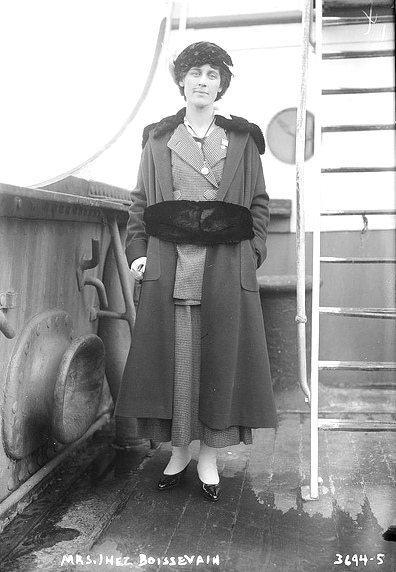
Inez Milholland Boissevain on board ship,
probably 1916. Photo L.O.C.
October 23, 2016–This day in 1916 Inez Milholland Boissevain gave her last public speech. The Los Angeles Herald story of Inez's collapse, which ran the next day, Oct. 24 (p. 6), is headlined: "Collapse of Mrs. Inez Milholland Boissevain at Lecture to Delay Campaign". The story continues:

Too ill to lift her head from the pillow following her collapse during a speech at Blanchard Hall last night, Inez Milholland Boissevain, New York suffrage beauty, will be halted in her transcontinental political campaign against the Democratic party. Under the care of her beautiful sister, Miss Vida Milholland, and a doctor, the famous suffragist will remain in Los Angeles for several days, confined to her bed. Although extremely ill and in great pain, Mrs. Boissevaln still championed her cause today.

With a magnificent glory of black hair falling around her white shoulders and over her pillow, dressed in a negligée of sapphire chiffon, she told of the many thrilling experiences she has had under the suffrage banner and what she expects to do in the future. Although she wants the vote more than anything else and her husband, a foreigner, has taken out his first naturalization papers, Mrs. Boissevain will not accept her enfranchisement at his hands.

"I certainly did not wish to lose my citizenship through marriage and I don't want to gain It that way.” she said. “Why should I? So Mr. Boissevain, at my especial request, has not taken out his final papers. He will wait until I can gain my own enfranchisement so that when I get the vote it will he because it is my right and not through his. I would rather wait until we have secured suffrage In New York and I have put through my first bill. That will be to make it a law that no woman loses her citizenship by marrying a foreigner unless she declares her intention of doing so at the time of her marriage. When I am enfranchised this way, by my own right, rny husband will continue the naturalization procedure.

“London suffragists are going to be enfranchised at the end of this war, but they never would have it they had not advertised beforehand what they wanted. We have to advertise. It is for this reason that I have led the New York women in parades, and in campaigns where we wrote 'Votes for Women' in chalk on the sidewalks.

"No London assault of suffragists was ever worse than the way in which the American suffragists were treated in Chicago the day they made their silent demonstration to President Wilson," Mrs. Boissevain declared.

“The London women were ridden down by mounted police and brutally treated. So were the women in Chicago. I have received letters telling me about it, and one woman wrote that she was knocked down and her teeth crushed out. It is horrible."

Mrs. Boissevain has participated in several London suffragette activities, at one time aiding in an attempt to storm Parliament. On that occasion she was saved from arrest and imprisonment by the mounted police, through the aid of a friendly policeman who hid her behind a large statue in a park until the authorities had passed on. “American men are more chivalrous to women than the English are, though,” Mrs. Boissevain concluded, “and if the enfranchised women will only give us a square deal we will win our national amendment soon.”

Related Posts: Eugen Jan Boissevain Bio .

Tuesday, October 4, 2016

INEZ | Oct. 4, 1916–Alva Belmont Sees Inez Off (Updated Nov. 7, 2016)

Alva Vanderbilt Belmont (L) and
 Inez Milholland Boissevain.
Oct. 4, 1916.
Alva Belmont saw Inez off on her trip west with her sister Vida to rally the pioneer women in the new States where their right to vote in Federal elections was recognized.

Her departure for the west was covered as follows in The New York Times on the day she left:
Mrs. Inez Milholland Boissevain will start today on an anti-Wilson speaking tour, which will cover every important town in the States where women have the franchise. Mrs. Boissevain said yesterday she was the last of more than a hundred suffragists who have left New York this Summer on similar missions. Mrs. Boissevain will make her first speech in Cheyenne, Wyoming.
Belmont was entitled to be by the side of Inez because she was the first-named contributor to the campaign for suffrage organized by the Congressional Union, which was described in a 1916 New York Times story as a "wing" of the National Woman's Party. The total 1916 revenue for the Congressional Union was $111,423 ($2.5 million in 2016 dollars).

The other two women named first among the givers in 1916 were two other New Yorkers, Mrs. H. O. Havemeyer and Mrs. Elon Hooker. The only two men named as major donors were James Couzens of Michigan and New Yorker John E. Milholland, Inez's father.

When the finance committee of the C.U. was reorganized in late 1916, it was placed under three New Yorkers: Alice Carpenter, Chairman; Mrs. John W. Brannan, Treasurer; and Doris Stevens, for many years personal secretary to Alva Belmont.

Belmont also financed activities of labor organizers concerned about the working conditions of women in the garment industry.

L to R: Alva, Inez and Alice Paul.
(Library of Congress.)
Born in Mobile, Ala., she came to New York and married sequentially two of New York's wealthiest men, William K. Vanderbilt and Oliver H. P. Belmont (his father was banker August Belmont and his mother was Commodore Matthew Perry's daughter). She lived on Fifth Avenue and also built a castle at Sands Point, L.I. that is said to be the model for the Great Gatsby's Long Island home. She was a major supporter of aggressive action for women's rights in New York State and the National Woman's Party in Washington. Her support of women's causes may well be the reason New York State was the first state to vote for women suffrage.

Belmont and Milholland had worked together on the garment workers strike in 1909, when Milholland was in her first year at NYU Law School.

Inez's trip to the West was also financed by her father, John E. Milholland. He had a reason for not wanting President Wilson re-elected because he had denounced Wilson's Postmaster-General for slavery-like conditions on his properties in the West.

A devout Presbyterian and a Lincoln Republican, John E. Milholland believed he was bidden by God to speak out against racism.

Sources include: 
"Mrs. Boissevain Off Today," New York Times, October 4, 1916.
"Financing the Federal Campaign," The Suffragist, Jan. 31, 1917.

INEZ LTRS | Oct. 9, 1916–EJB to IMB Letter

EJB to IMB (Eugen Jan Boissevain to Inez Milholland Boissevain), Undated, Probably Oct. 9, 1916 [2 of 11 in October; the dates of Eugen's letters are a puzzle]. Annotations by JT Marlin.

[Inez Milholland Boissevain's first speech was in Cheyenne, Wyoming. The green line is the main
Union Pacific RR. The red line is the Utah & Northern RR, which connects Salt Lake City with
Butte and Helena, Mont. and became part of UPRR. Thanks to Spellerweb.]


EUGEN BOISSEVAIN & CO., INC.
Exporters & Importers
27 William Street, New York

Sweetheart,

     I sent you today the blouse & stationery c/o Mrs. Pintus, Salt Lake City. [Envelope dated Oct. 10 was sent to Mrs. W. D. Ascough, c/o Dr. Mark Dean, Helena, Montana, which maybe would be the next stop.]
     I am going tonight to a "première" of a play [The Walker's Auto-Da-Fé] by [Arturo M.] Giovannitti with Art Young & Mrs. [The  play is a monologue, the 1912 address to the jury following the Lawrence, Mass. "Bread and Workers" Strike. Giovannitti was a poet who came to the United States in 1900 and became a "Wobbly", a member of Industrial Workers of the World.] We dine together at the Brevoort. [The Café Brevoort, once at 11 Fifth Avenue, in the hotel of the same name, was from 1902 to 1933 owned by Raymond Orteig, who put up the $25,000 prize money for which Lindbergh flew across the Atlantic. Frequent visitors included Mark Twain and Eugene O'Neill.]
     Crystal [Eastman] married Walter Fuller two months ago [nowhere was I able to find the date of this wedding; must not have been well attended].
     Nothing known re Stielow [mentally challenged upstate man convicted hastily of murder of a visitor to the community with frail evidence, defended vigorously by Inez Milholland]. Will wire you as soon as I know.–Keeping in touch with the chief, or rather Miss Phoebe.–

Related Posts: Eugen Jan Boissevain Bio . Oct. 23, Inez Collapses in LA .

Tuesday, September 6, 2016

CENTENNIAL | Sep 7–Catt's Atlanta Speech (Updated Apr 6, 2017)


Carrie Chapman Catt (1859-1947), née Carrie Clinton Lane.
She gave a rousing speech for suffrage in 1916, as the National
Woman's Party was touring the country for Votes for Women.
Sep 7, 2016—This day 100 years ago, in Atlanta, Carrie Chapman Catt gave one of the great speeches of the 20th century.


She was trying to get women to support a federal suffrage amendment.

Her goal was to rally her suffragist troops in one of the most difficult parts of the country.  


She was born Carrie Clinton Lane on January 9, 1859 in Ripon, Wisc. (birthplace also of the Republican Party).

Carrie was the only woman in her class of 1880 from Iowa State College. She graduated first in her class. 


She became a teacher and then Superintendent of Schools in Mason City, Iowa and married newspaper editor Leo Chapman in 1885. Chapman, sadly, died of typhoid fever a year later. 

In 1890, Carrie was married again, to Iowa State alum George Catt, an engineer. Their pioneering prenup allowed her to devote two months in the spring and two months in the fall to suffrage issues. That same year, the two main U.S. organizations advocating suffrage, the NWSA and the AWSA, came together as the National American Woman Suffrage Association (NAWSA) through the work of Anna Howard Shaw and others.

In 1894, Carrie Catt supported Susan B. Anthony’s argument that the existing U.S. electoral system included many ignorant men who posed “great danger” to America, while excluding many educated women.  In the face of strong resistance in southern states to adding more people to the electorate, Anthony and Catt considered some kind of educational test or standard that would allow educated women to replace less-educated men.

Anthony in 1900 selected Catt to be her successor as president of NAWSA in 1900-1904. Catt decided that the organization was diffusing its resources by plodding along in every state. To  speed things up, she decided to focus all of the organization's resources on getting a federal amendment.  Subsequently labeled her “Winning Plan,” she sought to prioritize and refocus NAWSA's work  in different states: 
  • In states that had passed legislation recognizing women's right to vote in presidential elections, mostly in the West, NAWSA sought passage of a federal suffrage (Anthony) amendment.
  • In states that did not have presidential suffrage, but where there was a prospect of successfully amending their state constitution, NAWSA pressed for a referendum.
  • In most other states, NAWSA worked toward presidential suffrage via the legislature.
  • In Southern states, where prospects were weak, NAWSA just sought suffrage in the primaries.
Catt resigned her position as NAWSA president in 1904 to look after her ailing husband George Catt. He died in 1905, leaving Carrie with an independent income; four months later, in February 1906, Susan B. Anthony died. 

Anna Howard Shaw took over NAWSA between 1904 and 1915 and by the end of her presidency NAWSA had 44 state auxiliaries, each with local branches, and more than two million members.  

In the first decade of the 20th century, NAWSA was based primarily in New York City, where several large donors were located. In December 1912 NAWSA hired Alice Paul and Lucy Burns, who had recently been in London and had worked with the Pankhursts on suffrage campaigns, to revitalize NAWSA's Congressional Committee in Washington, D.C. This morphed after the successful parade of March 1913 into the more independent Congressional Union and then in 1916 into the National Woman’s Party, as its activist leaders (notably Paul and Burns) parted ways from the larger and slower-moving NAWSA. 

Catt once again headed up NAWSA in the key years 1915-1920, and at President Wilson's request in 1917 pledged that NAWSA would support the war effort.  Catt created war-effort departments within NAWSA including Food Conservation, Protection of Women in Industry, and Overseas Hospitals. Catt herself also served in the Women’s Division of the Liberty Loan Committee. The first-ever Congresswoman, pacifist Jeanette Rankin, took her seat at that time. Although Congress took up little legislation unrelated to the war, the House of Representatives joined the Senate in creating a Woman Suffrage Committee, and NAWSA participated in hearings of the Senate's Woman Suffrage Committee. 

NAWSA volunteers were not always available for ongoing suffrage work on the amendment because many had volunteered for war service on the home front. Women’s support for the war effort was one argument used in favor of suffrage when Wilson changed his mind and supported a suffrage amendment in 1917. 

The Congressional Union included many pacifists like Dorothy Day, Crystal Eastman and Inez Milholland who did not support the war effort and focused only on suffrage. After World War I, Catt became a leader in work for world peace.

The House passed the Anthony Amendment on January 10, 1918, after a Congressional speech of support by President Wilson and much effort by suffragists. Catt was received by President Wilson for congratulations and thanks shortly after the vote. When the Amendment was finally passed by both houses of Congress (on the third try) in 1919, Catt led NAWSA’s coast-to-coast effort for its ratification by the then-minimum of 36 states. 

In 1920, having achieved its goal, NAWSA was replaced by the League of Women Voters, which had been founded the previous year.  The League was created to educate the electorate in a non-partisan manner, to register voters, and to encourage women to run for office. Catt’s exceptional organizational skills were vital to achieving American women’s right to vote, and to ensuring that women participate in the electoral and governing process.

Catt developed a strong international presence. In 1902 Catt co-founded and served as president until 1923 of the International Woman Suffrage Alliance, active today as the International Alliance of Women. Although she won favor with President Wilson for her work with the American war effort, she later became an active leader for world peace and when she died in 1947 she left her significant estate, including many books, to form the Iowa State Peace Library.

Atlanta Speech Excerpt

Here is an excerpt from the end of the speech that Catt gave in Atlanta 100 years ago, one of two by Catt that rate as among the top 100 speeches of the 20th century:
Shall we play the coward … and leave the hard knocks for our daughters, or shall we throw ourselves into the fray, bare our own shoulders to the blows, and thus bequeath to them a politically liberated womanhood. 
We have taken note of our gains and of our resources! and they are all we could wish. Before the final struggle, we must take cognizance of our weaknesses. Are we prepared to grasp the victory? Alas, no! our movement is like a great Niagara with a vast volume of water tumbling over its ledge but turning no wheel. Our organized machinery is set for the propagandistic stage and not for the seizure of victory. 
Our supporters are spreading the argument for our cause; they feel no sense of responsibility for the realization of our hopes. Our movement lacks cohesion, organization, unity and consequent momentum. 
Behind us, in front of us, everywhere about us are suffragists–millions of them, but inactive and silent. They have been "agitated and educated" and are with us in belief. 
  • There are thousands of women who have at one time or another been members of our organization but they have dropped out because, to them the movement seemed negative and pointless. Many have taken up other work whose results were more immediate. Philanthropy, charity, work for corrective laws of various kinds, temperance, relief for working women and numberless similar public services have called them. Others have turned to the pleasanter avenues of club work, art or literature. 
  • There are thousands of other women who have never learned of the earlier struggles of our movement. They found doors of opportunity open to them on every side ... but they feel neither gratitude to those who opened the doors through which they have entered to economic liberty nor any sense of obligation to open other doors for those who come after.  
  • There are still others who, timorously looking over their shoulders to see if any listeners be near, will tell us they hope we will win and win soon but they are too frightened of Mother Grundy to help. There are others too occupied with the small things of life to help. They say they could find time to vote but not to work for the vote. There are men, too, millions of them, waiting to be called.  
These men and women are our reserves. They are largely unorganized and untrained soldiers with little responsibility toward our movement. Yet these reserves must be mobilized. The final struggle needs their numbers and the momentum those numbers will bring. 
Were never another convert made, there are suffragists enough in this country, if combined, to make so irresistible a driving force that victory might be seized at once. 
How can it be done? By a simple change of mental attitude. If we are to seize the victory, that change must take place in this hall, here and now!
Sources 

Belcher-Hamilton, Lisa. “The League of Women Voters.” Cobblestone, November 1988, pp. 35-6.

Catt, Carrie Chapman, Home of. Carrie Chapman Catt Childhood Home .


Concise Dictionary of American Biography, 5th Edition, Volume 1. New York: Charles Scribner’s Sons, 1997, pp. 199-200.

Current Biography 1940. Maxine Block, ed. New York: H. W. Wilson, 1940, pp. 150-152.

Library of Congress, Carrie Chapman Catt Collection.

Morton, T. , Speed the Plough (1798). This comedy led to the contemporary catchphrase "What will Mrs Grundy say?"

National American Women 1607-1950: A Biographical Dictionary, Vol. 1. Edward James, ed. Cambridge, Massachusetts: Belknap Press of Harvard University Press, 1971, pp. 309-13.

National Women’s Hall of Fame, "Women of the Hall".

Reference Library of American Women, Vol.1. Farmington Hills, Michigan: Gale Research, 1999, pp.123-4.

Sherr, Lynn and Jurate Kanzickas. Susan B. Anthony Slept Here: A Guide to American Women’s Landmarks. New York: Random House, 1994.

Turning Point Suffragist Memorial website. Plan for a suffrage memorial in Lorton, Va.

Webster’s American Biographies. Springfield, Massachusetts: Merriam-Webster, Inc., 1984, pp. 67-8.

Women’s Almanac. Volume 2: Society. Linda Schmittroth and Mary Reilly McCall, eds. Detroit: UXL – Gale Research, 1997, pp. 250-51.

Thursday, August 25, 2016

BIRTH | Aug. 6–Inez Milholland is 130 (Updated Aug. 25, 2016)

Inez Milholland Boissevain (1886-1916)
This day in 1886, in Brooklyn, N.Y., was born Inez Milholland Boissevain, who gave her life working to persuade President Wilson to support a U.S. constitutional amendment recognizing the right of women to vote.

Women won the right to vote at the Federal level in 1920, four years after she died.

Milholland was a graduate of Vassar College and NYU Law School who also fought for the rights of working-class women, spoke out for racial equality, and worked for prison reform.

At Vassar, her suffrage meetings were banned from the campus, so she held them across the street at a Poughkeepsie Cemetery.

For six years, she was involved in the drive for Votes for Women in New York, memorably lobbying state lawmakers and leading annual suffrage parades up Fifth Avenue.

In 1913, she fought for the inclusion of black college women in the Woman Suffrage Parade in Washington, D.C., and she famously led it the wearing a cape and crown atop a white horse.

Inez and Eugen Boissevain, 1913
In July 1913, she married Eugen Boissevain (my mother's uncle) in London, asking her friends to keep it a secret. However, someone called the newspapers and it was front-page news the next day. A New York Times editorial called her "the fairest of the Amazons".

In 1916, she became a “Flying Envoy” on a speaking tour of the western states on behalf of the National Woman's Party. In October 1916, after the rhetorical question, “Mr. President, how long must women wait for liberty,” she collapsed before a large audience in Los Angeles, Calif. She died a month later of pernicious anemia.

On Christmas Day, an unprecedented memorial was held for her in the U.S. Capitol’s Statuary Hall, the first woman to be honored there.

The following  month, suffragists from the National Woman's Party presenting memorials of Milholland's death were rebuffed by President Wilson. They then began picketing the White House and carried her last words on many of their banners. The picketing led to arrests, imprisonment, hunger strikes, forced feeding, national outrage and a change in President Wilson's mind (not his first). The 19th Amendment was ratified by the last required state (Tennessee) in August 1920.

Inez Milholland Boissevain personified the goal of Votes for Women.

Monday, August 22, 2016

EUGEN | Guglielmo Marconi, Friend and Relative

Marconi
Dr. Marc Raboy's new book on Guglielmo Marconi published by the Oxford University Press has just appeared. It was reviewed yesterday by Greg Milner (author of Pinpoint: How GPS is Changing Technology, Culture and Our Minds).

Prof. Raboy holds the Beaverbrook Chair in Ethics, in the Media and Communications Department of Art History and Communications at McGill University in Montreal.

Raboy credits me with providing some details in his book about Marconi's mother's family that I sent to him in an email on July 26, 2012. I am posting here information I sent, in the hope that it will be useful to other researchers on the Milhollands, the Boissevains or the Marconis.

My link to Raboy was Linda Lumsden, who wrote a fine biography of Inez Milholland–book that made it unnecessary for me to rush out my own book into the void I saw about her life story.  Instead, I worked on a play about her that was first produced in New York City Hall, then migrated to Rochester, and was then produced as a staged reading in Inez Milholland's birthplace, Lewis, N.Y.  (Linda was kind enough to attend this event.) This year is the centennial of Inez Milholland's death and I am rewriting my play for a group in the Washington, D.C. area that is interested in producing it.

In my email to Prof. Raboy, I cited several connections between Eugen Boissevain and Guglielmo Marconi. Here is a slightly edited version of what I told him in 2012: 

1. Both were engaged to Inez, Guglielmo for a few months and Eugen for the rest  of her short life. Guglielmo expected Inez and Eugen to hit it off. (He had a hunch she would go for a hunk.) My mother Hilda van Stockum was Eugen's niece and told me used to tell me things that Eugen passed on to her. Apparently Guglielmo told Eugen that he was passing his old flame onto him because she needed someone like Eugen–someone more masculine (or "stronger" may have been the way he put it) than he, Guglielmo, was. Eugene's bother Robert had been in New York already for some time and already knew Inez through his second wife (who had been personal secretary to Alma Smith Vanderbilt Belmont, a big funder of the woman suffrage movement), so Eugen was well-informed about the woman he was to meet for the first time at the Holland House in June 1913.

2. Both liked going to Irish pubs. They engaged in an Irish-pub crawl in New York and from the context it was not the first such evening out that they spent together.

3. Eugen worked for Guglielmo's company, Marconi Wireless, for a while in London–probably working with investors, which I think of as Guglielmo's obsession, although I may be projecting onto the Marconi company the worries of Inez's father about the Batcheller company. The Bankers' Panic of 1907-08 was similar to that of 2008-09 so they would still be facing risk-averse investors.

4. Both were intellectually curious. But Guglielmo was more a nerdy scientist and Eugen was more a wide-ranging free-thinker, which is the biggest thing that John E. Milholland held against him.

5. Both had Irish mothers who were first cousins from the Jameson family in Ireland, still famed for their whiskey. The Jamesons were distinguished in Ireland because of the brand was well-known and well-loved and  because they were enriched by sales of their product. They were also Protestant Irish. In New York City Protestant circles the Jameson product might have been less highly regarded because a Protestant Irishman like John E. Milholland might well have been a Prohibitionist. (It was Prohibition that united Catholics and Jews against the Protestants.)  My nephew Chris Oakley in London wrote up an explanation of the relationship between the two Jameson mothers. The Jameson family came together during the summers at Glen Lodge on the edge of Lake Sligo in Northwest Ireland. My mother has visited there many summers. Sligo (which means "abundant in sea shells") is the largest urban area in northwest Ireland. Sligo is three-quarters Catholic, but the sympathies of the Jamesons during the 1910s and 1920s would have gravitated to the British. (It is a county in the Province of Connacht, one of the four provinces of the Éire Republic. The nine Ulster counties, six of which constituted the Northern Ireland Province of the United Kingdom, are immediately to the east.)

See also related posts: Let's Get that Mountain Renamed . Recognizing Stanton and Anthony . Aug. 6–Milholland's 130th Birthday . How Did Eugen Meet Inez?